Apparel · season budget & shoot order

Product photography vs lookbook: what to shoot first.

If you already know the difference, product photography vs lookbook is not a definitions question — it is a sequencing and budget question. The answer is that you shoot the lookbook first, lock the brand-spine document it sets, and derive the product-on-white and PDP frames from the same garments and the same casting inside one production. Get the order right and a forty-to-eighty-SKU season is shot once and used everywhere — PDP, linesheet, email hero, paid frame, feed depth — off one garment pull, one colour profile and one invoice. Get it backwards and you shoot every garment twice: once clinically for the catalog, once again for the brand, with two studios, two model registers and two colour profiles the customer reads as two brands. For operators at the three to thirty million band — Reformation, DÔEN, Buck Mason, Aimé Leon Dore, Vuori, Ulla Johnson — this is the page about the split and the order, not the definitions.

By Abhi Chawla, founder · Last updated: 2026-06-19

One production, both outputs

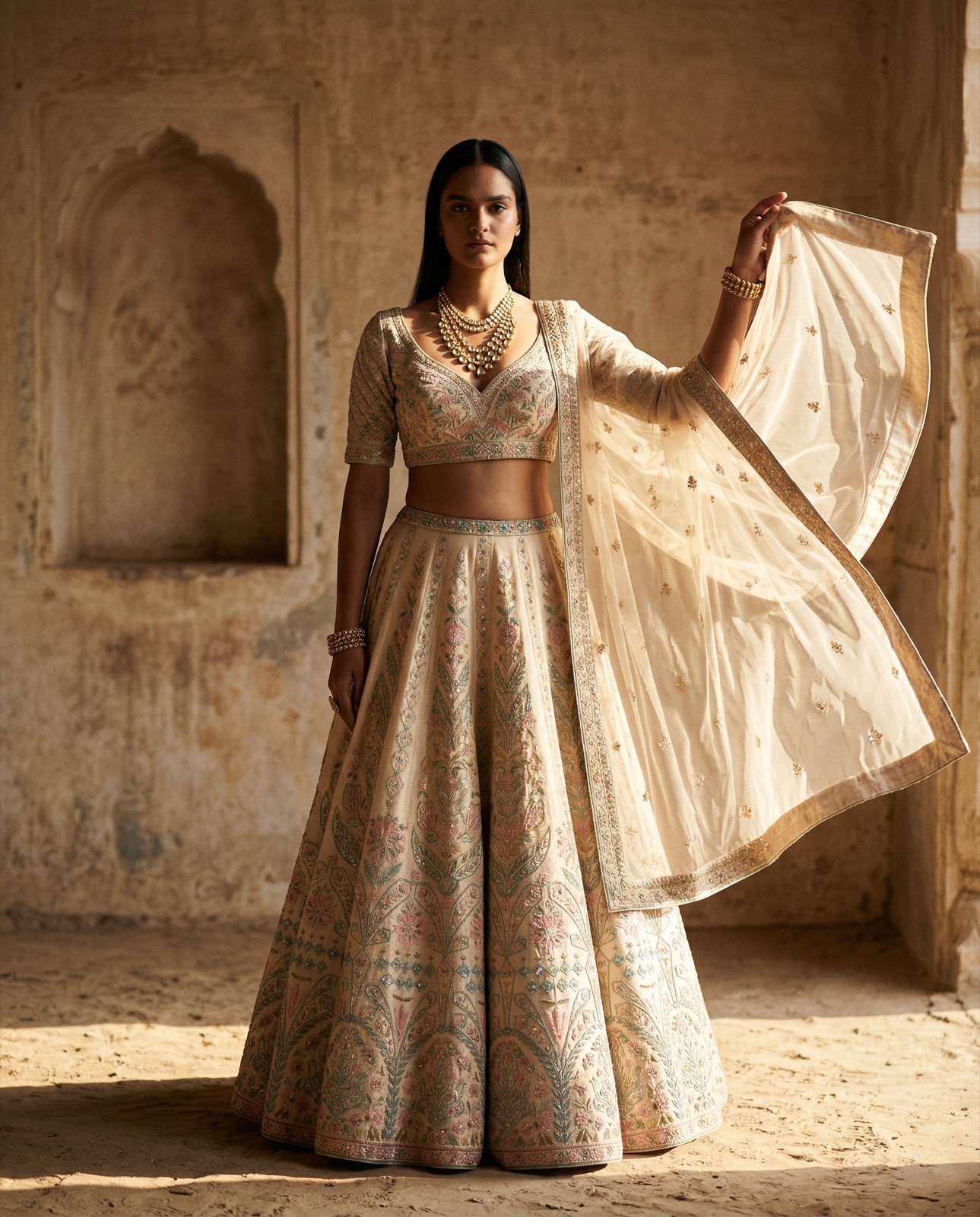
The lookbook look and the product frame, composed against one brand spine.

You already know the difference. You are stuck on the order.

It is the Monday the season has to be greenlit. The line sheet is locked at sixty-two SKUs. The product shooter has quoted the PDP coverage — front, back, detail, on-figure, two-hundred-odd frames, e-commerce-clean, eleven thousand. The campaign photographer has quoted the lookbook — twelve looks, location half-day, stylist, talent, post, thirty-eight thousand. Two vendors, two calendars, two colour-management setups, two casting decisions. The founder reads both quotes and the question is not what is a lookbook versus a product shot. The founder knows. The question is which one gets shot first, what the split should be, and why the brand is about to pay to photograph the same sixty-two garments twice.

That double-photographing is the buried cost in product photography vs lookbook, and it is invisible on either quote in isolation. The product shooter shoots the linen maxi on a clean backdrop in cool, even, shadowless light tuned for fit accuracy. Six weeks later the campaign photographer shoots the same maxi on location in warm directional golden hour for the brand. Same garment, two colour profiles, two model registers, two days of garment handling, two rounds of sampling-and-pull logistics. The customer who scrolls the warm feed frame and clicks through to the cool PDP reads the temperature shift before she reads the price. Two invoices bought one garment photographed as two brands.

This page is the sequencing answer for the operator who has already read the difference between a lookbook and product photography and does not need it explained again. The difference is settled. What is not settled on most brands is the order, the ratio and the production model that gets both outputs out of one cycle. Get that wrong and the season costs forty percent more than it should and reads as two brands. Get it right and the season is shot once and used everywhere.

Shoot the lookbook first, then derive the product frames.

The order is counter-intuitive to most founders, who assume you shoot the clean PDP first because it is the urgent, sell-now layer, then add the lookbook later if budget allows. That sequence is exactly backwards. The lookbook is what sets the brand-spine document — the colour register, the light direction, the casting frame, the styling logic, the negative-space ratio. Every product frame should be composed against that spine so the PDP reads as the same brand as the feed. Shoot the PDP first and you have nothing to compose the brand against; shoot the lookbook first and the product layer inherits a spine for free.

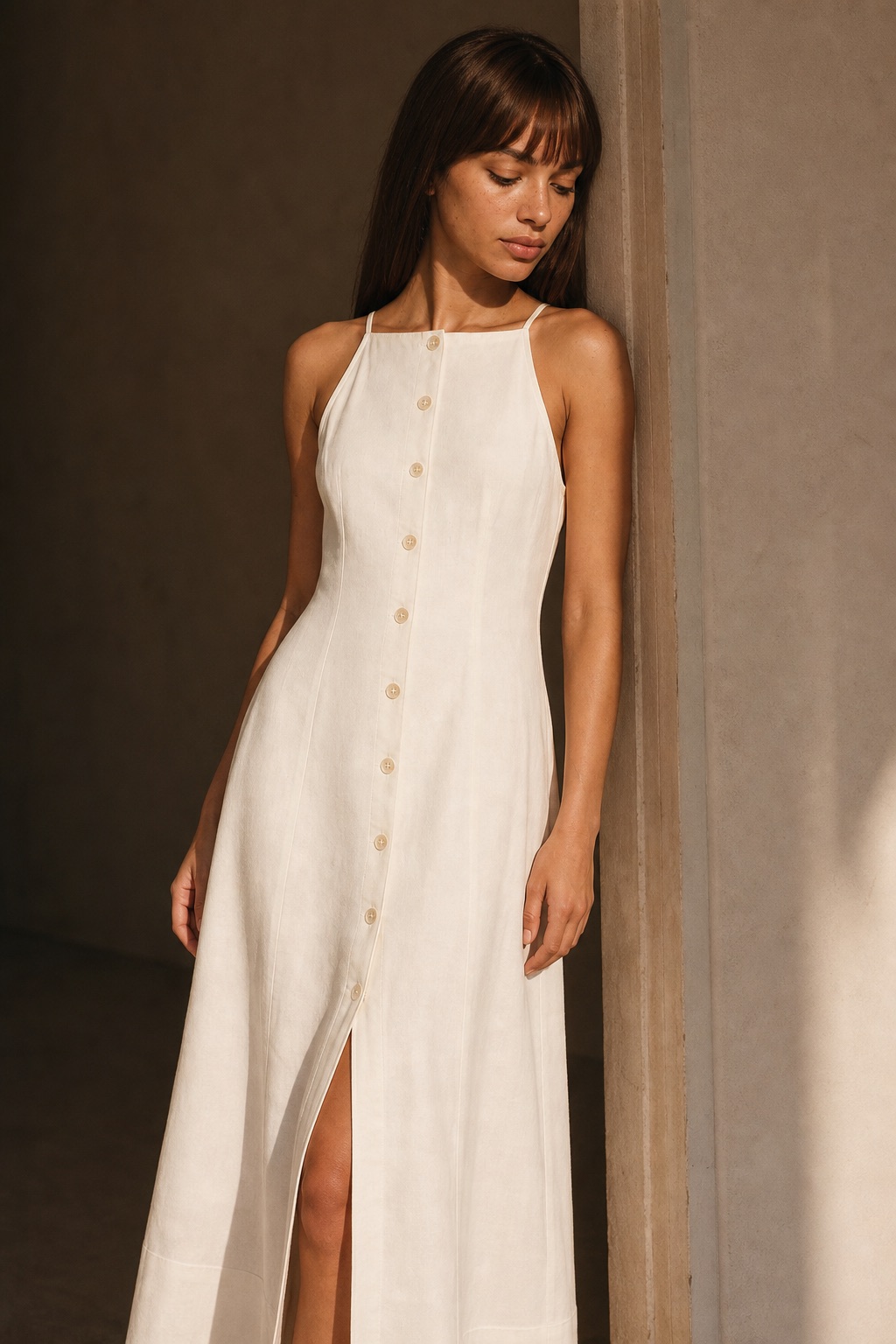
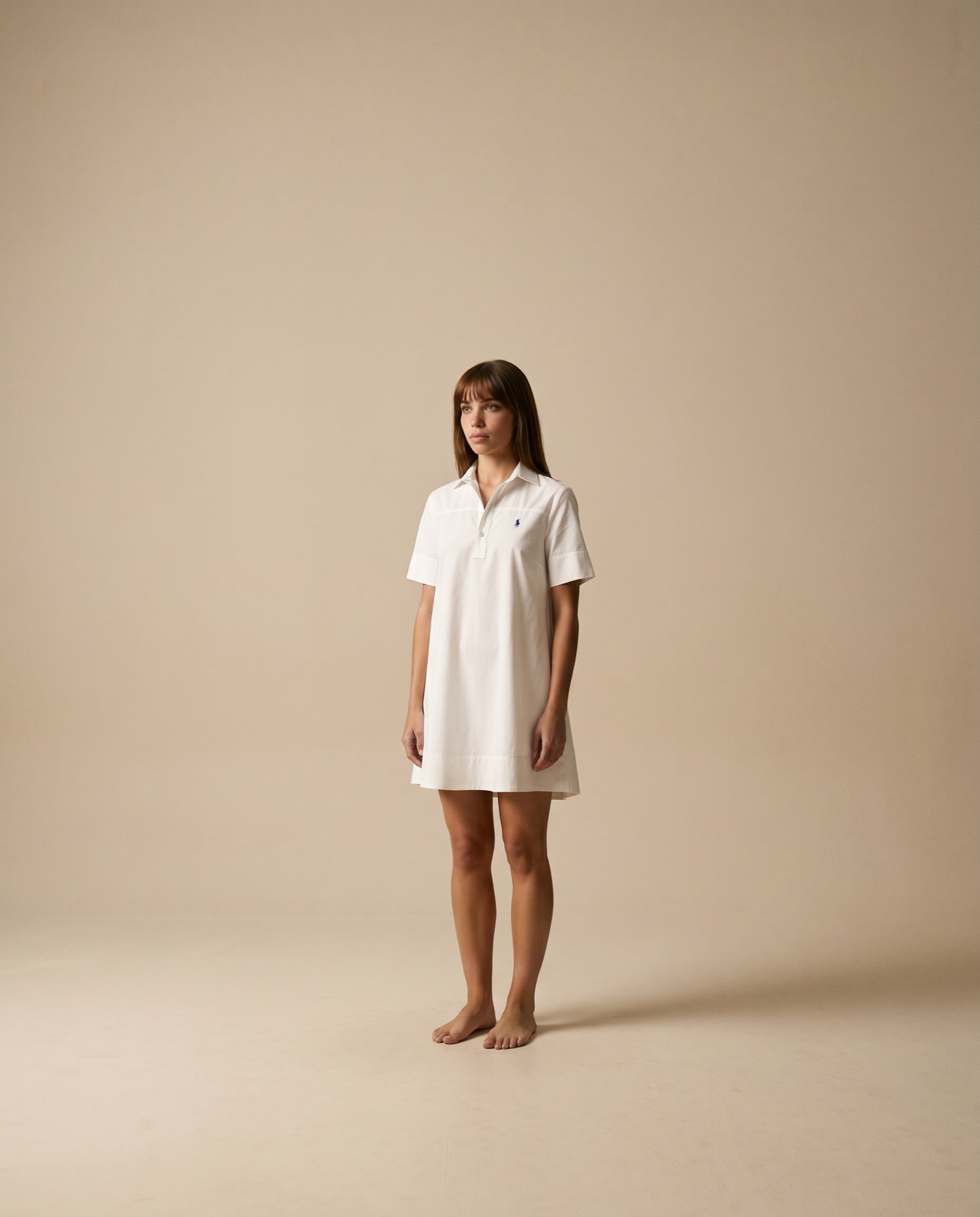
Mechanically, the lookbook frame and the product-on-white frame are the same garment under two briefs. The Veronica Beard linen maxi shot as a lookbook look — leaned against a warm plaster column, front slit catching directional light — and the same maxi shot front-and-back on a clean backdrop for the PDP are one garment pull, one steam, one casting frame, one colour profile, two setups inside one session. The Ralph Lauren polo shirtdress on the seamless beige backdrop with large negative space is the on-figure PDP frame; the same dress in the rainforest editorial is the lookbook layer. Composed against one spine in one cycle, the customer cannot tell they were not shot on the same day. They were.

The buyer-intent version of the decision, then, is a production order, not a definitions table. Lock the spine off the lookbook. Derive the on-figure PDP, the product-on-white front-back pair, the ghost-mannequin and the flat-lay detail from the same garments and casting in the same cycle. Crop everything to every channel aspect ratio in the DAM. This is the same shoot-once discipline that powers apparel wholesale photography, where the linesheet thumbnail and the lookbook deck cover have to come off one production or the buyer reads two brands across the deck. The order is the answer.

Why the budget split and the frame count move in opposite directions.

The split that trips founders up is that the money and the frame count point opposite ways. On the budget line, the lookbook and brand layer takes sixty to seventy percent and product photography takes thirty to forty — because the lookbook carries location, styling, talent direction and the named environment, while product-on-white is high-volume, low-cost-per-frame, repeatable coverage. On the frame count it inverts. A sixty-SKU season ships one-hundred-twenty to two-hundred-forty product frames — two to four per SKU for front, back, detail and on-figure — against only twelve to twenty lookbook looks, roughly one to three looks per ten SKUs depending on how many garments combine into a styled look.

So the product layer is the high-count, channel-flat job and the lookbook is the low-count, brand-carrying job, and the budget reflects difficulty per frame rather than number of frames. The split is not a rule to memorise — it is an output of two inputs: how many SKUs you are selling and how many channels you are cutting for. A forty-SKU brand cutting only for a PDP and one feed has a very different split from an eighty-SKU brand cutting for PDP, marketplace, wholesale linesheet, email, Pinterest and paid. Model the season against your own SKU and channel numbers rather than a generic ratio, and the split falls out of the inputs.

The reason the ratio matters at greenlight is cash sequencing. A brand that spends its whole photography line on a single forty-thousand lookbook and then has no budget left for accurate PDP frames has a beautiful homepage and a conversion leak on every product page. A brand that spends it all on clean product-on-white has a catalog with no want behind it. The split exists to fund both jobs out of one production cycle, which is the lever scaling a DTC fashion brand with content turns when CAC is rising and the feed needs brand depth and the PDP needs conversion-grade frames at the same time.

Three ways brands buy the season — and what each actually costs.

Path A

Two vendors, two shoots, two invoices

The product shooter handles PDP coverage; the campaign photographer handles the lookbook on a separate day. Quotes look reasonable in isolation — eleven thousand for product, thirty-eight for the lookbook on a sixty-SKU season. The hidden cost is the same sixty-two garments handled, steamed, pulled and photographed twice across two colour-management setups and two casting decisions. The PDP runs two stops cooler than the feed, the model is a tier off the campaign hero, and the customer reads two brands moving from the ad to the product page. The math closes on paper and breaks in the feed.

Path B

One layer only, the other deferred

Budget covers product photography or the lookbook, not both, so the brand ships clean PDP frames and a homepage with no brand layer — or a beautiful lookbook and a conversion leak on every product page. The deferred layer becomes a recurring next-quarter line that never gets approved because the urgent layer always wins. Three seasons in, the brand has a full catalog and still no coherent brand world, or a strong feed and PDPs the dot-com team is quietly apologising for. The false either-or compounds into a structural gap.

100 Creatives

One production, both outputs, one spine

The lookbook leads and sets the brand-spine document; the on-figure PDP, the product-on-white front-back pair, the ghost-mannequin and the flat-lay detail are derived from the same garments and casting in the same cycle, composed against one colour register at under three Delta E drift. A sixty-SKU season ships its twelve-to-twenty looks and its one-hundred-twenty-plus product frames off one garment pull and one calendar, cropped to every channel in the DAM. The customer moving from the feed to the PDP never reads a temperature shift. The season is shot once and used everywhere.

What shooting the season once instead of twice actually saves.

Run the two-vendor model on a sixty-SKU season and the all-in lands between fifty and seventy thousand — eleven to eighteen for the product coverage, thirty-five to fifty for the lookbook, plus the invisible second handling of every garment, the duplicated colour management and the producer hours spent coordinating two calendars that never quite align. The duplication is not a line item anyone quotes; it is the four hundred to twelve hundred dollars per frame the traditional model carries because every garment is touched twice and every setup is built twice. On a two-hundred-frame season that overhead alone is the difference between one campaign and two.

The shoot-once model collapses the duplication. One garment pull, one casting frame, one colour profile, one production calendar producing both the lookbook looks and the full product layer composed against one spine. On the per-frame economics a brand-world studio operates against, the product frames ship at eighty to one-hundred-eighty dollars rather than four-hundred-plus, and the lookbook looks come off the same cycle rather than a separate location day. The season's photography line lands closer to the cost of one of the two old quotes, not the sum of both — and the brand recovers the second handling, the second colour setup and the producer time that never showed on either invoice.

The second-order saving is on the calendar, not the cash. A founder coordinating two vendors, two shoot days and two rounds of garment logistics spends fifteen to twenty-five hours per season being the producer between studios. Shot once off one spine, that time goes back to the brand. The same compression is what lets a brand running frequent drops keep both layers current without a per-drop production scramble — the discipline documented across the DTC content-volume model where the PDP and the feed both have to stay fresh on a budget the CFO can actually model.

The PDP frame converts the want. The lookbook frame creates it.

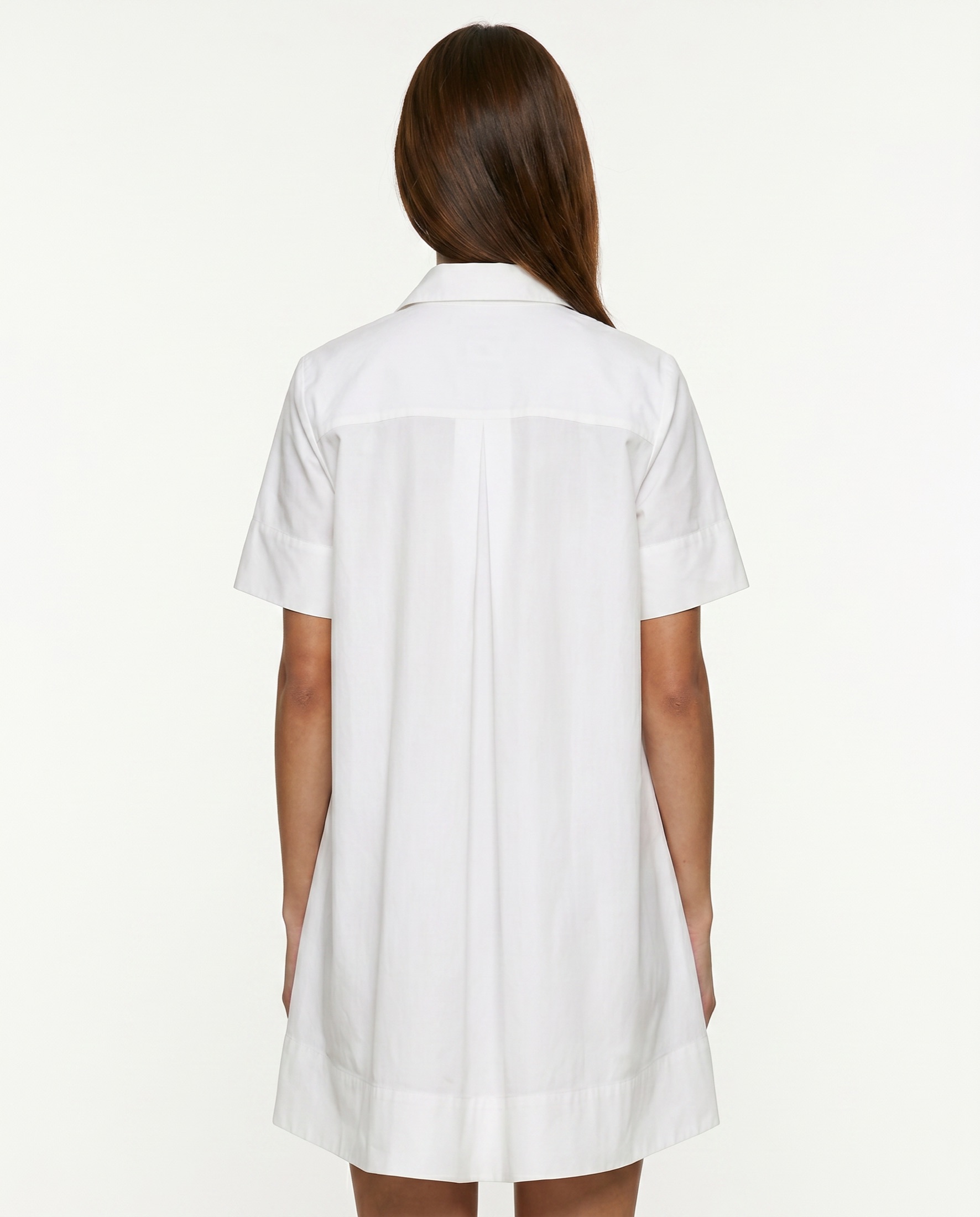
Product photography lives where the customer needs accuracy. The PDP front-back-detail set, the marketplace listing, the wholesale linesheet thumbnail, the retargeting frame that follows a known-intent shopper — these all do the same job: read fit, fabric, colour and construction without ambiguity, so the customer who already wants the garment can buy it with confidence and not return it. The Ralph Lauren rear-view frame showing collar, yoke and hem exists for exactly this. It is not trying to create desire. It is removing the last doubt between desire and checkout.

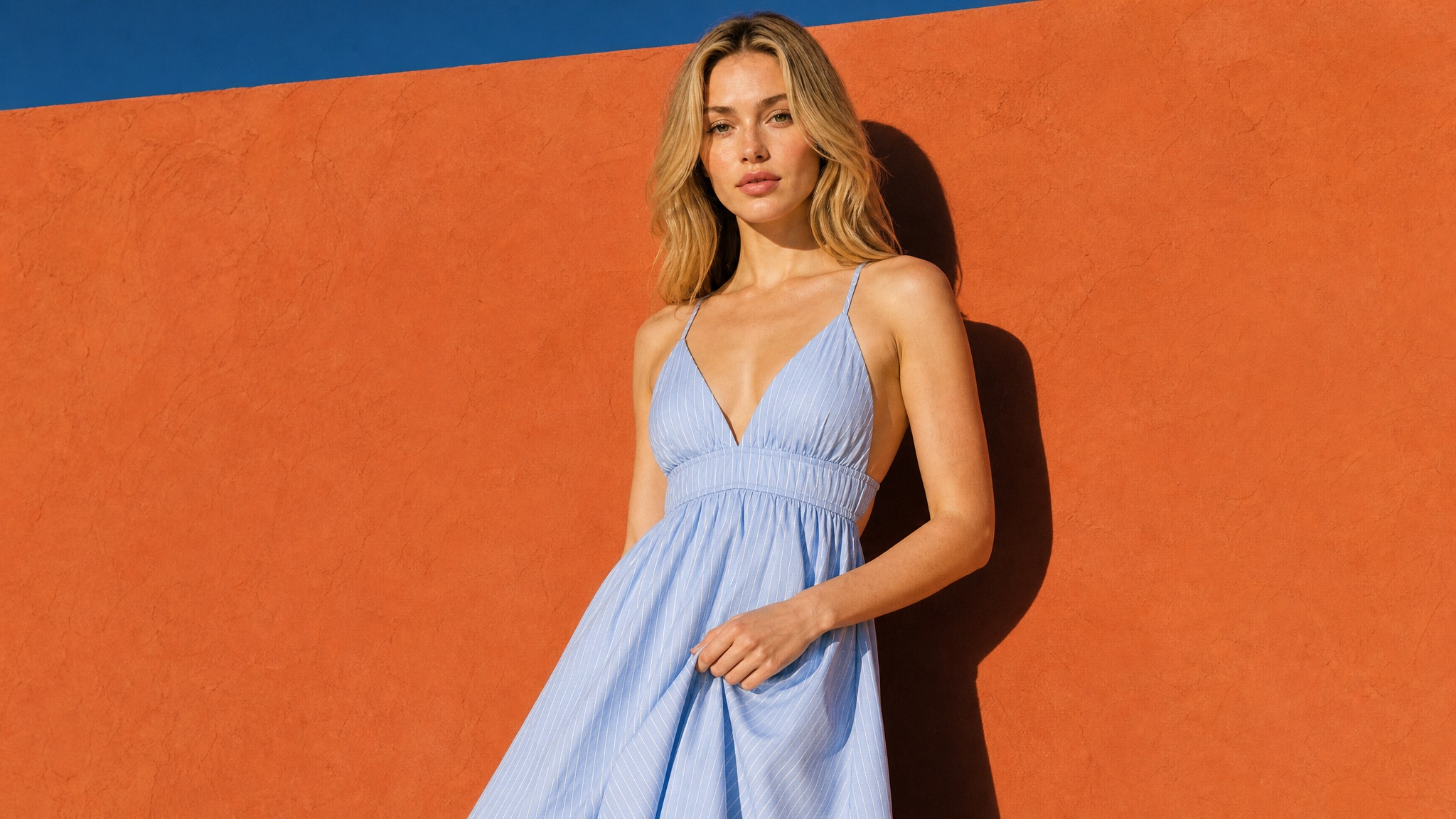
The lookbook lives where the customer needs the world. The brand homepage, the seasonal landing page, the wholesale deck cover, the email hero, the campaign feed — these create the want the PDP later converts. The Aritzia pinstripe sundress against the terracotta wall in warm Mediterranean light is not a fit reference; it is a register, a season, a feeling the customer wants to belong to. The same garment does both jobs in different frames, which is the whole reason the order matters: the lookbook frame teaches the customer to want the thing the product frame then sells her.

The brand that wins is the one where moving from the lookbook frame to the product frame feels like staying inside one world rather than crossing between two vendors. That continuity is purely a function of composing both against one spine — one colour register, one casting frame, one light logic. The customer never thinks the word "consistency"; she just never gets the small jolt of a cooler, flatter PDP after a warm, dimensional ad. The jolt is what kills the conversion the lookbook earned. Removing it is the entire payoff of shooting product photography and the lookbook as one production.

Product photography vs lookbook · frequent questions

Product photography vs lookbook — which do I shoot first for a season?

Shoot the lookbook first, then derive product photography from the same garments and the same casting frame inside one production. The lookbook sets the brand-spine document — colour register, light direction, casting identity, styling logic — and the product-on-white and PDP frames are then composed against that spine so the catalog and the brand read as one season. Reverse the order and you end up shooting the garments twice: once clinically for the PDP, once again for the brand, with two colour profiles, two model registers and two invoices. The order that closes the math is one shoot, both outputs, lookbook leading.

What is the right budget split between product photography and the lookbook?

For a brand at the three to thirty million revenue band running a forty-to-eighty SKU season, the working split is roughly sixty to seventy percent of the photography budget on the lookbook and brand layer and thirty to forty percent on product-on-white and PDP coverage — but only because product photography is the higher-volume, lower-cost-per-frame line. On a frame count it inverts: you ship two to four product frames per SKU and one to three lookbook looks per ten SKUs. The split is not a rule, it is an output of the SKU count and the channel matrix. Send us the season line sheet and we will model the split against your own SKU count.

Can one production deliver both product photography and the lookbook?

Yes — and that is the entire buyer-intent argument. The lookbook look and the product-on-white frame are the same garment under different briefs. Composed against one brand-spine document in one production cycle, the on-model lookbook frame, the ghost-mannequin PDP frame, the flat-lay detail and the front-back e-commerce pair all come out of the same session with one colour profile and one casting identity. The traditional model splits them across two studios and two invoices because the product shooter and the campaign photographer are different vendors. A brand-world studio composing both against one spine removes the seam.

How many product photography frames versus lookbook looks does a season need?

Product photography is SKU-bound: two to four frames per SKU for the PDP — front, back, detail, on-figure — so a sixty-SKU season is one-hundred-twenty to two-hundred-forty product frames. Lookbook is story-bound: one to three looks per ten SKUs depending on how many garments combine into a single styled look, so the same sixty-SKU season is roughly twelve to twenty lookbook looks. The product layer is high-count and channel-flat. The lookbook layer is low-count and carries the brand. Budget the two as different jobs, produce them in one cycle.

Where does product photography live versus where the lookbook lives?

Product photography lives on the PDP, the marketplace listing, the wholesale linesheet thumbnail and the retargeting ad where the customer needs to read fit, fabric and colour accurately. The lookbook lives on the brand homepage, the seasonal landing page, the wholesale deck cover, the email hero and the campaign feed where the customer needs to read the world the garment belongs to. The same garment does both jobs in different frames. The PDP frame converts the customer who already wants it. The lookbook frame creates the want.

If the budget only covers one, product photography or lookbook?

Product photography, every time, if the brand is selling now and the PDP is the only thing standing between the customer and checkout. You cannot ship a season without accurate front-back-detail frames on every SKU — the conversion stops without them. The lookbook is the layer you add the moment the brand needs to create demand rather than only capture it. But the trap is treating it as a permanent either-or. A brand-world studio ships both off one production at a per-frame cost that makes the false choice unnecessary by the second season.

How do you keep the product photography and the lookbook reading as one brand?

By composing both against the same brand-spine document — colour register in Pantone-locked sRGB at under three Delta E drift, one light direction, one casting frame, one negative-space logic — rather than briefing the product shoot to a catalog vendor and the lookbook to a campaign photographer separately. The failure mode every operator has seen is a PDP that is two stops cooler and a model two casting tiers off the campaign hero. When both come out of one production composed against one spine, the customer moving from the feed to the PDP never reads a temperature shift.

What is the production order that gets a season shot once and used everywhere?

Lock the brand-spine document, shoot the lookbook looks against it, derive the on-figure PDP and product-on-white from the same garments and casting in the same cycle, then crop everything to every channel aspect ratio in the DAM. One garment pull, one casting frame, one colour profile, one production calendar, every output the season needs — lookbook, PDP, linesheet, email hero, paid frame, feed depth. The season is shot once and used everywhere. That sequence is the whole answer to product photography vs lookbook for an operator who already knows the difference and just needs the order.

Plan the season

Send the line sheet. We'll map the shoot order.

If you already know the difference between product photography and a lookbook and you are stuck on the order, the split and how to get both out of one production — send the season's SKU count and the active campaign hero, and we will map the shoot order, the frame count per layer and the budget split against your own channels. The lookbook leads, the product frames derive from the same casting, and the season ships once and works everywhere. Send your brand and we'll reply with a plan — abhi@paperkites.co.

Plan the season's shoot order