Uniform apparel campaign photography

Uniform and team apparel photography where the decoration is a specification, not a styling decision — and the spec can be rendered before it can be sewn.

By Abhi Chawla, founder · Last updated: 2026-09-07

This is the production contract for the founder, head of brand or program lead at a $3M to $50M uniform, corporate apparel or team kit business at the Cintas, UniFirst, Vestis, Alsco, Aramark, Hedley & Bennett, Tilit, Chef Works, FIGS, Jaanuu, Medelita, Custom Ink, Real Thread, BSN Sports, Augusta Sportswear, Charles River Apparel, Vantage Apparel and independent SanMar-decorator tier — where the person approving your photograph will never wear the garment. Uniform apparel campaign photography is a production discipline for uniform, corporate and team apparel programs in which a client's decoration is rendered at exact specification — placement measured in inches from the shoulder-neck point, thread and ink colors named by code, method identified — across every garment and every role in the program range, so a buyer can approve a six-hundred-person program from imagery rather than waiting ten business days for a physical sew-out.

The register

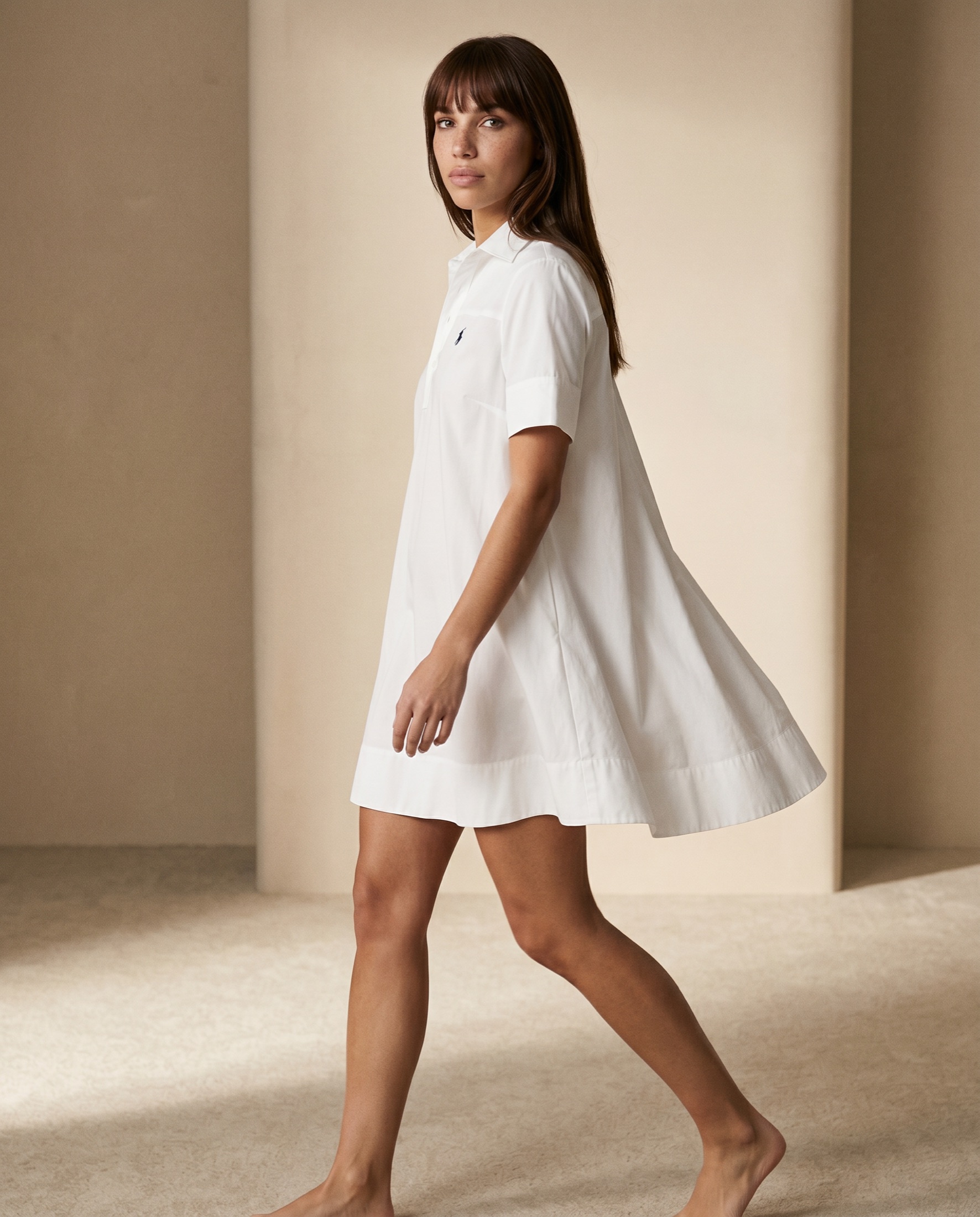
Heritage menswear construction at the seam, weave and hardware fidelity a uniform program has to survive — the register we build as uniform apparel campaign photography.

The sample lead time is longer than the decision window.

It is a Tuesday in early February. A hospitality group running eleven restaurants across three concepts has put a 640-person uniform program out to bid — front of house, back of house, bar, culinary leadership and a small corporate tier — worth somewhere around $410,000 across three years including replenishment. Your response is due in nine business days. Your decorator needs ten to digitize the three concept marks, sew a first strike-off, correct the density on the two that pull, and ship them to you. The arithmetic does not close, and it has never closed, and every supplier bidding against you is stuck inside the same arithmetic.

So everyone does the same thing. You pull the blank photography from the SanMar, alphabroder or S&S Activewear catalog, drop the client's logo onto the left chest in Photoshop at whatever scale looks reasonable on screen, and build a twenty-two-page deck out of stock garments on size-medium mannequins against seamless white. The buyer opens four of those decks in the same week. They all look identical, because they are all built from the same blank library, and none of them shows what the buyer is actually being asked to approve.

This is the structural problem in the category, and it is not a creative problem. It is a sequencing problem. In direct-to-consumer apparel the photograph exists to persuade a person to spend their own money on a garment they will wear themselves, so beauty is the job. In uniform and team apparel the photograph exists to persuade a facilities director, an athletic director, a group operations lead or a hospital supply-chain manager to commit several hundred thousand dollars on behalf of hundreds of people who had no vote. That reader is not falling in love. That reader is checking whether the mark is at the right height, whether the navy matches the other eleven navies already in the building, whether the women's cut exists, whether it survives an industrial launderer, and whether the whole thing reads as one program rather than eight separate purchases.

Your prospect is approving a garment for six hundred people they will never meet, from a photograph of a garment that does not exist yet. The only question worth asking is whether that photograph is a real proof or a composite guess — and for almost every supplier in this market, today, it is a composite guess. That is the entire opportunity, and it is available to whoever renders the specification first.

Left chest is not a placement. Three and a half inches down, four inches over is a placement.

Every uniform program lives or dies on a placement sheet, and almost no uniform photography is built from one. A placement sheet enumerates each decoration position with a finished dimension and a measured origin: left chest at three and a half inches down and four inches over from the shoulder-neck point at a three-inch finished width; full back at eleven inches down from the collar seam at a twelve-inch width; sleeve hit at four inches up from the cuff edge; nape at one inch below the collar seam; collar stand, cuff, and — for the cap component of nearly every program — crown front, side panel and back closure. Build the imagery from that sheet and the picture is reproducible by the factory. Build it from a designer's eye and you have produced a document the production floor will contradict.

The second half of the sheet is method, and this is where most program imagery quietly falls apart. Flat satin-stitch embroidery throws a directional sheen along the run of the stitch and only reads as embroidery when the light rakes across that direction. Three-dimensional puff sits over two to three millimetres of foam and needs a hard source to cast the shadow that proves the lift is there. Plastisol screen print sits on top of the fibre and reads glossy; water-based discharge sits inside it and reads matte, which is the whole reason a chef coat program specifies discharge and a promotional tee program does not. Heat-transfer vinyl reveals its cut edge only at a grazing angle. Tackle twill has a stitched perimeter and a fabric field that behave as two different surfaces. Sublimation has no surface at all — it is the fabric — and photographing it under embroidery light makes an expensive full-dye kit look like a cheap print.

One light logic across all six methods collapses the expensive ones into the cheap ones. That is not an aesthetic loss, it is a margin loss: the buyer who cannot see the difference between a $14 embroidered polo and a $9 heat-pressed one will choose on price, and you will have built the document that made that choice for them. The same discipline governs the way we treat handwork and surface fidelity in the couture register on the Anita Dongre program, where the entire commercial argument sits in thread behaviour at close range and dies under flat light.

Thread and ink specificity belongs in the frame too. A program mark is not "navy" — it is a named thread code and a named ink, and holding it consistently across a poly-cotton pique polo, a cotton twill chore coat, a brushed-back performance quarter-zip, a bistro apron and a structured cap is genuinely hard, because the same code reads differently on each substrate. Showing that consistency deliberately, rather than hoping it survives, is one of the few provable claims available in a bid. The cap component in particular deserves its own treatment rather than an afterthought crop, for the reasons we set out at length in headwear and cap brand campaign imagery — crown geometry and decoration behave nothing like a flat chest panel.

The cross-role lineup is the only frame the buyer actually wants.

Ask a hospitality group's operations lead what they are worried about and they will not say fabric weight. They will say that right now their host looks like a different company from their bartender, their kitchen looks like a third company, and their catering staff at an off-site event look like nobody at all. The uniform program is being bought to fix a legibility problem, and the frame that proves the fix is one image containing every role standing together under a single light in the correct hierarchy — host, server, runner, line cook, sous, bartender, manager — each in their correct garment with their correct decoration.

Healthcare runs the same logic on a bigger matrix: patient intake, nursing, tech, transport, environmental services, physician and administrative, frequently color-coded by job family so a patient can identify a role across a corridor at eight feet. Industrial and field service adds a compliance layer — the high-visibility tier has to read at its ANSI/ISEA 107 class and type, and flame-resistant garments carry NFPA 2112 and, for electrical utility work, ASTM F1506 marking that a safety manager will look for in the photograph before anything else. Collegiate and scholastic athletics run home, away and alternate across the full sport roster, with number height and mark placement governed by the rules NFHS and the NCAA publish for each sport rather than by anyone's design preference.

Almost nobody produces this frame, and the reason is purely logistical. Building it traditionally means every garment in the program sewn and decorated, every size present, six to twelve fit models booked, a stylist, and all of it converging on a single studio day. Miss one sample and the frame is unusable, because a lineup with a hole in it advertises the hole. That is a three-to-four-week critical path in a nine-business-day window, which is why the category has quietly agreed to present grids of isolated garments instead — and why the supplier who shows up with the lineup is not competing on the same axis as the other three bidders.

The lineup also does something a grid cannot: it fixes relative scale. A three-inch left-chest mark on a size-small women's poplin and the same mark on a 3XL men's twill are visually different objects, and the buyer only discovers that when two employees stand next to each other on the floor in month one. Deciding it in the presentation is free. Discovering it after the first thousand units ship is not. This is the same evidentiary logic we apply to the wholesale deck in wholesale lookbook and linesheet imagery, where the deck is not a marketing asset — it is the order.

Reference frames

Three registers a uniform program has to hold at once — the frame grammar behind uniform apparel campaign photography.

The cost moves from per-program to per-range — and then it amortizes across every bid you answer.

Run the arithmetic on a single mid-size program. Eight roles, three garments per role, is twenty-four program SKUs. At six frames each — on-form front, on-form back, decoration macro at the raking angle, the placement rule at both ends of the size range, and one in-environment frame — that is 144 frames for one presentation. A supplier answering twenty-five to forty program bids a year is looking at 3,600 to 5,760 frames annually, which at any traditional per-asset rate is a number nobody in this category has ever been willing to spend, which is precisely why the category presents on catalog blanks.

The structural fix is to notice that the garments repeat and the marks do not. You are not selling twenty-four unique products to this client — you are selling twenty-four selections out of a stocked range you already quote from every week: Port Authority, District, Sport-Tek, Carhartt Company Gear, Bulwark, Augusta, Badger, Holloway, Charles River, and whatever house program you carry. That range is finite, it changes once or twice a year, and it is the same range behind every bid you will answer for the next eighteen months.

So build the range once. Every blank in your quoting catalog, on-form, in every stocked colorway, at a fixed camera position and a fixed light. That is the library, and it is a capital asset rather than a project cost. Then each program becomes a mark pass against the library — the client's decoration rendered at their placement spec, in their thread and ink codes, at their method, across the twenty-four SKUs they selected — and it ships in 48 to 72 hours instead of three weeks, because nothing has to be sewn, shipped or booked. The frame-count logic here is the same one we lay out for high-SKU catalogs in ecommerce apparel photography at scale, but the multiplier is inverted: there the SKU count multiplies the shoot, here the client count multiplies a shoot you already did.

That inversion is the whole commercial argument, and it compounds in the direction that matters. The fifth program presentation costs the same as the fiftieth. The library carries into next year with a delta pass for range changes. And the win rate moves, because you are no longer one of four decks assembled from an identical stock library — a dynamic that will be familiar to anyone who has consolidated production across several labels the way we describe in multi-brand apparel portfolio production. For rental and managed-program operators the effect is stronger still, since the same library also feeds the employee-facing ordering site and the replenishment catalog, which is the same recurring-reveal problem we solve in apparel subscription and rental campaign imagery.

Uniform program imagery resolves into three models. The cost bands below sit alongside the DTC creative-cost breakdowns Common Thread Collective and Andrew Foxwell publish for apparel production, adjusted for the decoration, digitizing and sample-freight costs that a decorated-apparel program carries and that general apparel benchmarks do not account for.

Physical strike-offs plus a studio day

Three to four weeks, $6,500–$14,000 per program presentation once you count digitizing, sew-outs, sample freight, models, stylist and the studio. It produces genuinely correct imagery, and it is the right answer for a flagship account you have already won. As a bid response it forfeits the bids whose windows are shorter than the sample lead time — which, in hospitality and public-sector procurement, is most of them. Under calendar pressure the frames cut first are the size-range placement proof and the wash-cycle frame, which are the two that were preventing the disputes.

Catalog blanks with a composited mark

Effectively free, two days, and universally used. The tell is always the same: a mark at slightly the wrong scale, sitting flat with no thread relief, on a garment lit by someone else for a different purpose, with no back view, no second size and no cap. Buyers who have reviewed three bids in a week now recognise this instantly, and the deck stops being evidence and becomes a formality. It also cannot show a cross-role lineup at all, because the source catalog was never shot as one.

Blank library plus a per-program mark pass

The 100 Creatives model. $22,000–$48,000 to build the library once across your stocked program range, in four to six weeks, then $900–$2,400 per program presentation delivered in 48 to 72 hours. Digital strike-offs at spec, cross-role lineups, decoration-method comparison pairs, placement proof at both ends of the size range, in-environment frames and compliance reads. The library is an asset that answers every bid for the next eighteen months rather than a cost that dies with one deck — which is where this stops being cheaper and starts being a different business model.

Six rules that separate a program proof from a pretty deck.

01

Shoot from the placement sheet, not from the eye

Every decoration in every frame carries a written origin and a finished dimension — inches down and over from the shoulder-neck point, inches up from the cuff, inches below the collar seam — plus a stated rule for whether the mark scales with garment size or holds fixed across the range. If a frame cannot be traced back to a line on that sheet, the factory cannot reproduce it, and the image is decoration rather than proof. The sheet is also the artefact that survives a change of account manager, which in this business happens more often than a change of program.

02

Light each decoration method on its own terms

Flat satin embroidery gets light raking across the stitch direction. Puff gets a hard source that casts the shadow proving the foam lift. Plastisol gets a controlled specular that reads gloss without blowing out. Water-based discharge gets soft light that shows the ink sitting in the fibre. Heat-transfer vinyl gets a grazing angle that reveals the cut edge. Tackle twill gets both — perimeter stitch and fabric field are two surfaces. Sublimation gets flat, even light, because it has no surface at all and any raking source invents relief that is not there.

03

Prove the size range at its ends, never at its middle

A left-chest mark at a fixed three-inch width reads correct on a medium, crowded on an extra-small and lost on a 4XL. A mark that scales proportionally reads inconsistent when two employees stand side by side. Both behaviours are defensible and the client has to choose one, and they cannot choose from a size-medium photograph. Two frames — the smallest and the largest garment in the program, same mark, same spec — settle the question inside the presentation rather than at the first delivery, where it becomes a credit note.

04

Build the lineup before you build the grid

The grid of isolated garments answers the procurement checklist. The cross-role lineup answers the question the buyer is actually being paid to solve, which is whether their whole floor will read as one organisation. Produce the lineup first and let the grid fall out of it, because a lineup composed from a grid has inconsistent light, inconsistent scale and inconsistent camera height, and the eye reads that inconsistency as the program itself being inconsistent.

05

Photograph month nine, not just day one

Hospitality and healthcare garments run through industrial laundering on the cycles ISO 15797 describes, and the buyer's real anxiety is what the program looks like after a hundred of them. A frame pair at issue and at simulated wear — colour held, mark intact, twill unpilled, placket still square — is the single most persuasive image in a rental or managed-program bid, and it is the one image nobody in the category produces because you cannot photograph a garment that has not aged yet.

06

Put the garment in the room it will work in

Seamless white answers the catalog question and none of the operational ones. The kitchen pass, the clinic corridor, the warehouse aisle, the sideline, the trade-show booth and the hotel lobby each impose their own colour temperature and their own contrast against the uniform, and a navy that reads sharp on white can disappear against a dark walnut host stand. One in-environment frame per role tier tells the buyer what their floor will actually look like, and it is the frame that gets forwarded internally to the people who did not attend the presentation.

Four to six weeks to the library. Seventy-two hours to every program after it.

Weeks one and two are range definition and reference capture. We take your current quoting catalog — the styles you actually sell rather than the ones in the vendor book — and reduce it to the working range, typically sixty to a hundred and forty blanks across the polo, woven, knit, fleece, outerwear, apron, scrub, headwear and bottoms tiers. Reference comes from your existing samples, vendor spec sheets and whatever you already have on the shelf. This is where the placement sheet gets written, and where the thread and ink code libraries are fixed so the same navy is the same navy in every subsequent program.

Weeks three and four build the library itself: every blank, on-form, every stocked colorway, fixed camera position, fixed light, front and back, plus the macro position that decoration will later occupy. Nothing is decorated yet. The output is a neutral, reproducible, permanently reusable asset base — and the decision about whether people appear in it at all is a real one, which we treat the way we treat casting generally in AI fashion models versus real models: campaign and culture frames should carry real, cast, credited people, while the program proof layer is garment-led and does not need them.

Weeks five and six run the first two live program passes end to end so the workflow is proven against real bids rather than a demo. After that, each new program is a mark pass: you send the client's artwork, placement spec, thread and ink codes, method and selected SKUs, and the presentation set comes back in 48 to 72 hours — digital strike-offs, cross-role lineup, method comparison pair, size-range placement proof, in-environment frames, compliance reads where the tier requires them, and the marketplace and company-store crop sets. The fabric and construction fidelity that layer depends on is the same discipline we run for heritage and workwear substrates in workwear and heritage Americana campaign imagery, and the in-motion and performance tier — team kit, athletic staff, running and field programs — draws on the register we describe in activewear campaign imagery.

Two adjacent tiers deserve a note because they are routinely forgotten and routinely complained about. Maternity and postpartum sizing inside a healthcare or hospitality program is a real allotment line — FIGS and Jaanuu both carry it — and it needs its own frames for exactly the reasons we set out in maternity apparel campaign photography, because a maternity scrub top photographed on a straight block tells an employee nothing. And the consistency problem across a multi-concept group is a brand-system problem before it is a photography problem, which is the same argument we made producing at volume for Chobani, where one identity had to survive dozens of packages, formats and contexts without drifting. The comparative economics against a traditional studio path are broken down in AI photoshoot versus studio cost, and the broader case for running production this way sits in our guide to choosing an AI product photography agency and across our apparel ad creative work.

FAQ

Uniform apparel campaign photography, answered

What is uniform apparel campaign photography?

Uniform apparel campaign photography is a production discipline for uniform, corporate and team apparel programs in which a client's decoration is rendered at exact specification - placement measured in inches from the shoulder-neck point, thread and ink colors named by code, method identified - across every garment and every role in the program range, so a buyer can approve a six-hundred-person program from imagery rather than waiting ten business days for a physical sew-out. The deliverable is not a styled photograph. It is a proof document that happens to be beautiful enough to present.

Why do uniform programs get approved from imagery instead of physical samples?

Because the sample lead time is longer than the decision window. Digitizing artwork, running a sew-out, correcting the density and shipping the garment typically consumes eight to fourteen business days, while an RFP or program-review window is often five to fifteen. The arithmetic does not close. Suppliers therefore present on undecorated catalog blanks with the mark composited on flat, and the buyer approves a garment nobody has actually seen. Rendering the decoration to specification collapses that lead time to seventy-two hours and puts a real proof in front of the person signing.

What is a digital strike-off and what does it replace?

A digital strike-off is the client's mark rendered on the actual garment at the actual finished dimensions, in the specified thread or ink colors, with the surface behaviour of the specified method - satin stitch direction, fill density, underlay lift, plastisol build, vinyl edge - photographed at a raking angle where that behaviour is legible. It replaces the physical pre-production sample in the approval conversation, not in production. The decorator still sews the real sew-out before the run. What changes is that approval no longer waits on it.

What is a cross-role lineup frame and why does it win programs?

A cross-role lineup is one frame containing every role in the program - host, server, runner, line cook, bartender, manager, or intake, nurse, tech, transport, physician - standing together under a single light in the correct hierarchy, wearing the correct garment and the correct decoration for each role. It is the only frame that answers the buyer's real question, which is whether the program reads as one program. Almost no supplier produces it, because building it traditionally means every sample sewn and every fit model booked on the same day.

How should decoration placement be specified for photography?

In measurements, not adjectives. Left chest is not a placement; left chest at three and a half inches down and four inches over from the shoulder-neck point, at a three-inch finished width, is a placement. Every frame should be built from a written placement sheet covering left chest, full front, full back, sleeve hit, nape, cuff, collar stand and cap positions, with finished dimensions and a stated rule for whether the mark scales with garment size or holds a fixed dimension across the range. Photography built without that sheet produces pictures the factory cannot reproduce.

Do different decoration methods need different lighting?

Yes, and treating them alike is the most common technical failure in the category. Flat satin embroidery throws a directional sheen along the stitch run and needs light raking across that direction. Three-dimensional puff sits over foam and needs a hard source to cast the shadow that proves the lift. Plastisol screen print reads glossy and blows out under the same light that flatters embroidery, while water-based discharge sits in the fibre and reads matte. Heat-transfer vinyl shows its cut edge only at a grazing angle. One light logic across all five flattens the expensive methods into the cheap ones.

How does uniform photography handle a size range from XS to 6XL?

With placement proof at both ends of the range, not at the middle. A left-chest mark specified at a fixed three-inch width looks correct on a medium, crowded on an extra-small and lost on a 4XL, while a mark that scales proportionally reads inconsistent when two employees stand next to each other. That is a real program decision with a right answer per client, and it is unresolvable from a size-medium photograph. Two frames at the extremes settle it in the presentation instead of at the first delivery.

How much does uniform apparel campaign photography cost?

Physical strike-offs plus a studio day run roughly 6,500 to 14,000 dollars per program presentation over three to four weeks, and the sample lead time alone forfeits a share of the bids you would otherwise answer. Catalog blanks with a composited logo cost almost nothing and read as exactly what they are. A blank library built once across your stocked program range runs 22,000 to 48,000 dollars, after which each program presentation costs 900 to 2,400 dollars and ships in 48 to 72 hours, because the cost has moved from per-program to per-range.

How is uniform photography different from DTC apparel photography?

The buyer is not the wearer, and the image is not persuasion - it is evidence. In direct-to-consumer apparel a photograph convinces one person to spend sixty-eight dollars on a garment they will wear themselves. In uniform apparel the same photograph convinces one facilities director, athletic director or operations lead to commit several hundred thousand dollars on behalf of hundreds of people who had no say. That reader is checking specification compliance, not falling in love, and imagery built for desire rather than proof loses to imagery built for proof.

The program contract

Ready to answer the bid with a proof,
not a composite?

A blank library built once across your stocked program range, then digital strike-offs at spec, cross-role lineups, decoration-method comparison pairs, size-range placement proof, in-environment frames and compliance reads — 48 to 72 hours per program presentation.