Editorial AI photography · premium sustainable

Editorial-grade AI photography
for premium sustainable brands.

You are the founder or CMO of a slow-fashion, natural-beauty, or craft-heritage brand at $5M–$40M, and the brand-standards document on your desk names six editorial titles your imagery has to live inside — Cereal, Kinfolk, Apartamento, Vogue Living, World of Interiors, T Magazine. Your existing photography pipeline either costs $20k–$40k a day at the editorial studios that built brands like yours, or it breaks the brand inside three campaigns when you push it through a volume DTC studio. Editorial AI photography is the production discipline that holds the slow, observed, considered register at the volume a 60-SKU-per-collection cadence actually demands.

Last updated: 2026-05-20

The register

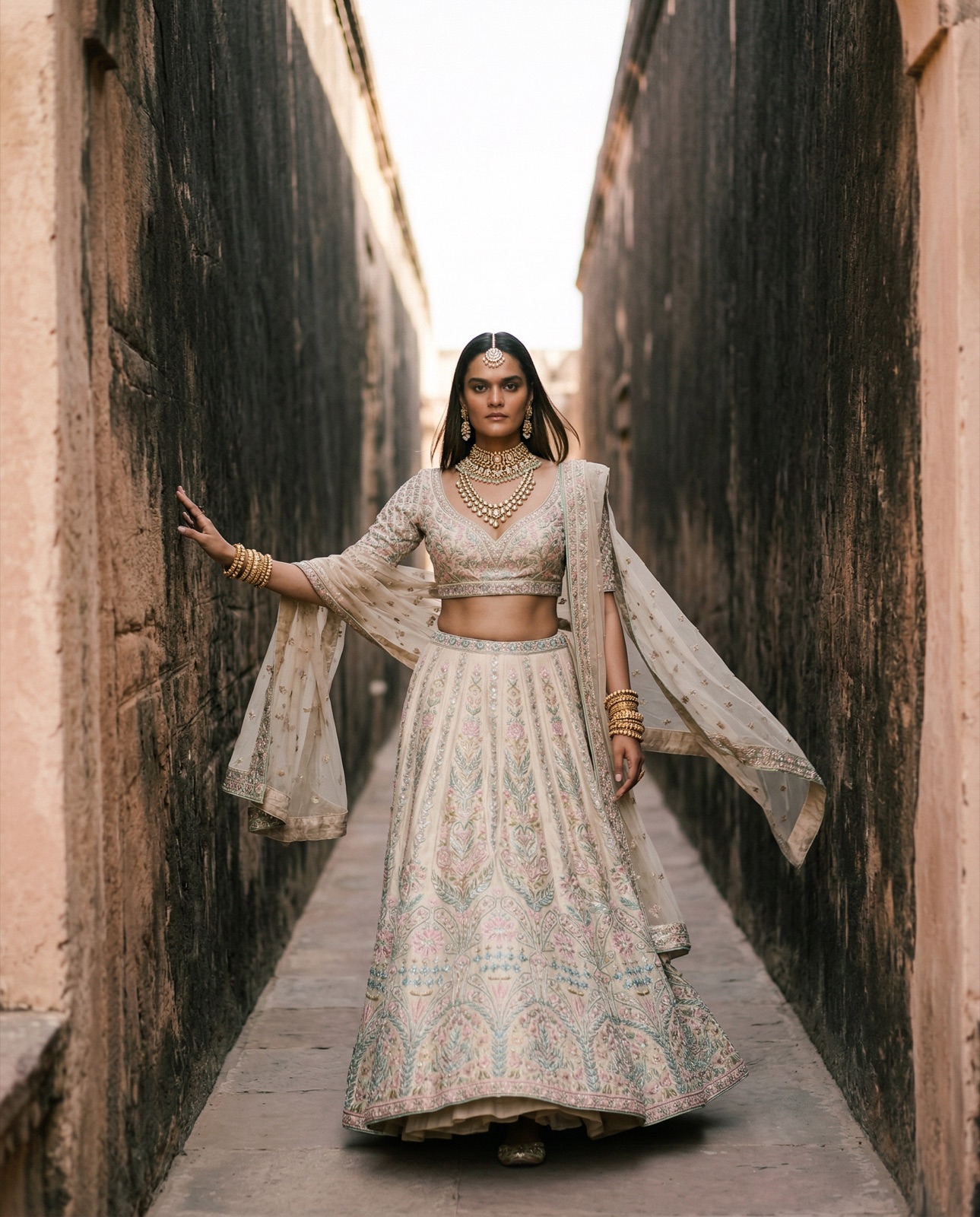
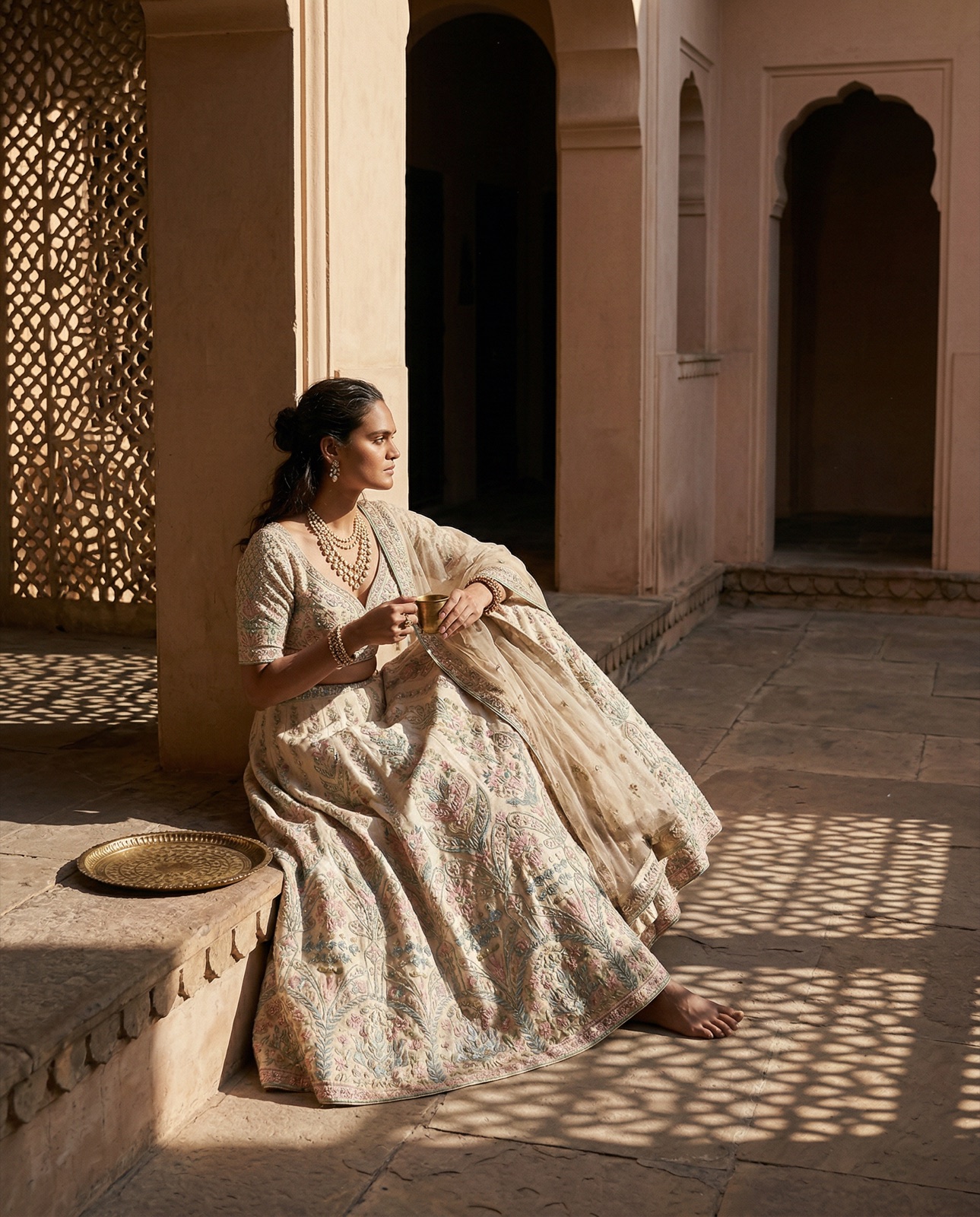
Anita Dongre hand-embroidered bridal — produced as editorial AI photography, registered against the brand's craft-heritage editorial spine.

Why volume DTC photography
breaks editorial brands

Most production studios shipping AI product photography in 2026 were built to feed Meta. Their entire instruction set is registered to performance-creative defaults — high-key fill across the frame, three-quarter framing, smiling models in mid-twenties posture, full-spectrum saturation pushed to maximum legibility on a four-inch phone in afternoon sunlight, fabric retouched flat, hand-stitch detail erased as "noise," skin retouched to plastic, backdrop bleached to absolute white at RGB 255, 255, 255. Every variable is optimised for the same end — stop the scroll inside the first 0.6 seconds at four-by-five aspect ratio in the Meta feed environment.

For a sustainable brand whose pricing is justified by craft, considered design, and natural materiality, every one of those defaults is a brand-wound. Eileen Fisher's photography does not pop. Toast's photography does not stop the scroll. The Row's photography barely has a product visible in the frame. Aesop's photography has more negative space than product. Christy Dawn's photography looks like it was taken on a Sunday morning by someone who knew the model personally. These visual choices are not stylistic accidents — they are the language that justifies the price point to a customer who pays $295 for a hand-loomed linen shift rather than $89 for a fast-fashion adjacent.

When a sustainable brand at the $8M–$30M ARR range tries to scale photography by retaining a volume DTC studio, the predictable failure sequence runs in three campaigns. Campaign one looks recognisably the brand because the founder has been close to every frame. Campaign two starts drifting — a slightly brighter key, a slightly happier model, a slightly fuller frame, a slightly cleaner backdrop. Campaign three is unrecognisable as the same brand. The customer who paid $295 last quarter sees an Instagram ad that reads like Vuori or Vuori-adjacent and the brand spell breaks. CAC starts climbing not because the algorithm changed but because the imagery stopped registering as the brand the existing customer base bought from. The same dynamic is what AI fashion photography at its best is built to prevent — and it is the failure mode this article is engineered around.

The problem is not capacity. It is registration. The production system has to be registered to editorial conventions before the first asset opens — not retroactively corrected after the brand drifts. That registration discipline is the differentiated mechanic in everything that follows.

The editorial register
in production specifications

"Editorial" is a word brands throw at briefs to mean "we want it to feel premium." It is a meaningless instruction unless it is decomposed into the technical variables that produce the look. Walk through the contact sheets of the editorial titles that built the sustainable luxury category — Cereal's photography, the photography in Apartamento, the rare full-bleed product spreads in Kinfolk before Kinfolk went mass — and you can map the register against twelve concrete production variables. Every one of these variables sits in a specific range. Outside that range the imagery stops registering as editorial.

Light direction is single, observed, and directional — almost always reading as a north-facing window in the early or late hours of the day, not high-key fill across the frame. The visible light source has a believable physical position. The shadow side of the subject is allowed to fall into 30%–50% of its full value rather than being bounced back to 90%+ by a reflector. Colour temperature lives in the 4900K–5400K natural-daylight band rather than the 5500K–6500K studio-white band. There is no warm-up filtration toward the gold or amber bias that volume hospitality photography defaults to. Skin tone holds its native value rather than being pushed toward the universal-attractive blend that fashion glamour photography produces.

Focal-length character is long — 85mm, 105mm, 135mm equivalent — not the 24mm to 50mm range performance creative defaults to. Depth of field is narrow. Aperture character reads f/2.0 to f/4.0. Composition leaves 40%–60% of the frame in negative space — a single object on untreated cream paper, a single model in a wide architectural frame, a flat lay with three objects and seven inches of empty paper around them. Gesture is neutral — the model is reading a book, looking through a window, standing on a porch — not laughing at the camera, not engaged with the audience.

Posture is observed rather than performed. Models read 30–60 rather than 22. Casting includes wrinkles, grey hair, and lived-in faces deliberately — the Eileen Fisher and Toast and Apiece Apart casting register that signals "this brand makes clothes for an adult life lived intentionally." Retouching preserves texture aggressively — weave irregularity in linen and silk noil, hand-stitch dimension, hand-embroidery raised relief, leather grain, ceramic glaze crackle, natural fibre slubs. The skin-smoothing default that volume DTC retouching ships with is explicitly disabled. Backdrop is untreated paper warm cream rather than bleached white. Hair has visible flyaways. Fabric has visible wrinkle. None of these are mistakes. They are the language.

The brand-spine ingestion
that locks editorial register

The differentiated mechanic in editorial AI photography is the eight-hour brand-spine ingestion session that opens every engagement. Not a creative kickoff. Not a brand-deck handoff. A working session that translates the brand's editorial register into a forty-to-sixty-page technical specification that becomes the production contract. Six things get locked.

01

Reference editorial set locked first

The first hour is the founder walking us through every editorial title, brand contact sheet, and reference frame that registers as the brand's visual world. Toast Magazine contact prints. Eileen Fisher's quarterly look-book. The Apartamento spread the founder still references three years later. Aesop's apothecary frame discipline. Eight to twelve voice frames get extracted from this reference set and become the benchmark against which every subsequent asset is reviewed. No frame ships if it does not register against at least one voice frame.

02

Photography rule lock

Hours two and three lock the twelve production variables — focal length range (typically 85mm–135mm equivalent), aperture character (f/2.0–f/4.0), light direction (e.g. "north-facing window, soft directional, late afternoon"), colour temperature band (typically 4900K–5400K), shadow-side preservation (no reflector fill above 60%), retouch rules (texture preserved, skin native, no smoothing), backdrop (untreated cream paper or weathered concrete or linen scrim), gesture (neutral, reading, observing), model age band, casting inclusion criteria, frame negative-space minimum, and saturation discipline.

03

Restricted palette discipline

Hour four locks the four-to-six colour palette per collection. Pantone references plus sRGB hex codes plus the do-not-render extension list. Sustainable brands almost always operate restricted palettes — Toast's six-natural-earth-tones, Christy Dawn's botanical-dye spectrum, Eileen Fisher's quiet-linen spectrum, Aesop's apothecary green-and-amber. This restriction is the signature. The production system locks the palette explicitly. If a colour outside the palette appears in a delivery, the frame fails review.

04

Texture preservation contract

Hour five locks the texture-preservation contract. Weave variation in linen and silk noil — preserved. Hand-stitch dimension — preserved. Hand-embroidery raised relief — preserved. Leather grain — preserved. Ceramic glaze crackle — preserved. Natural-fibre slubs — preserved. Skin micro-texture — preserved. Hair flyaways — preserved. Fabric wrinkle — preserved. The retouch defaults that ship with volume DTC pipelines are explicitly disabled at the system layer, not corrected frame by frame after delivery.

05

Backdrop and surface library

Hour six locks the backdrop and surface library — six to ten named surfaces the brand can use across its imagery. Untreated cream paper. Weathered teak. Hand-trowelled plaster. Raw linen scrim. Cold-rolled concrete with patina. Aged Carrara marble. Each surface is captured at production reference, locked into the spine, and consistently recognisable across every frame. The customer registers the brand partly through these surfaces. They become identity markers in the way Aesop's brutalist concrete shelves are identity markers.

06

Model identity lock

Hours seven and eight lock model identity. For sustainable brands the casting is half the brand — Toast's models read 35–55 and have lived-in faces, Christy Dawn's models read California natural-light bohemian, Maggie Marilyn's models read New Zealand outdoor-craft. We lock two to four model identities per brand for the engagement duration. Same model across the catalog, same model across collections, same model in lookbook and PDP. The recognition consistency is what allows a sustainable brand to compound recognition across two to three years of imagery — the same posture you saw last spring is on the campaign you are seeing now.

The discipline

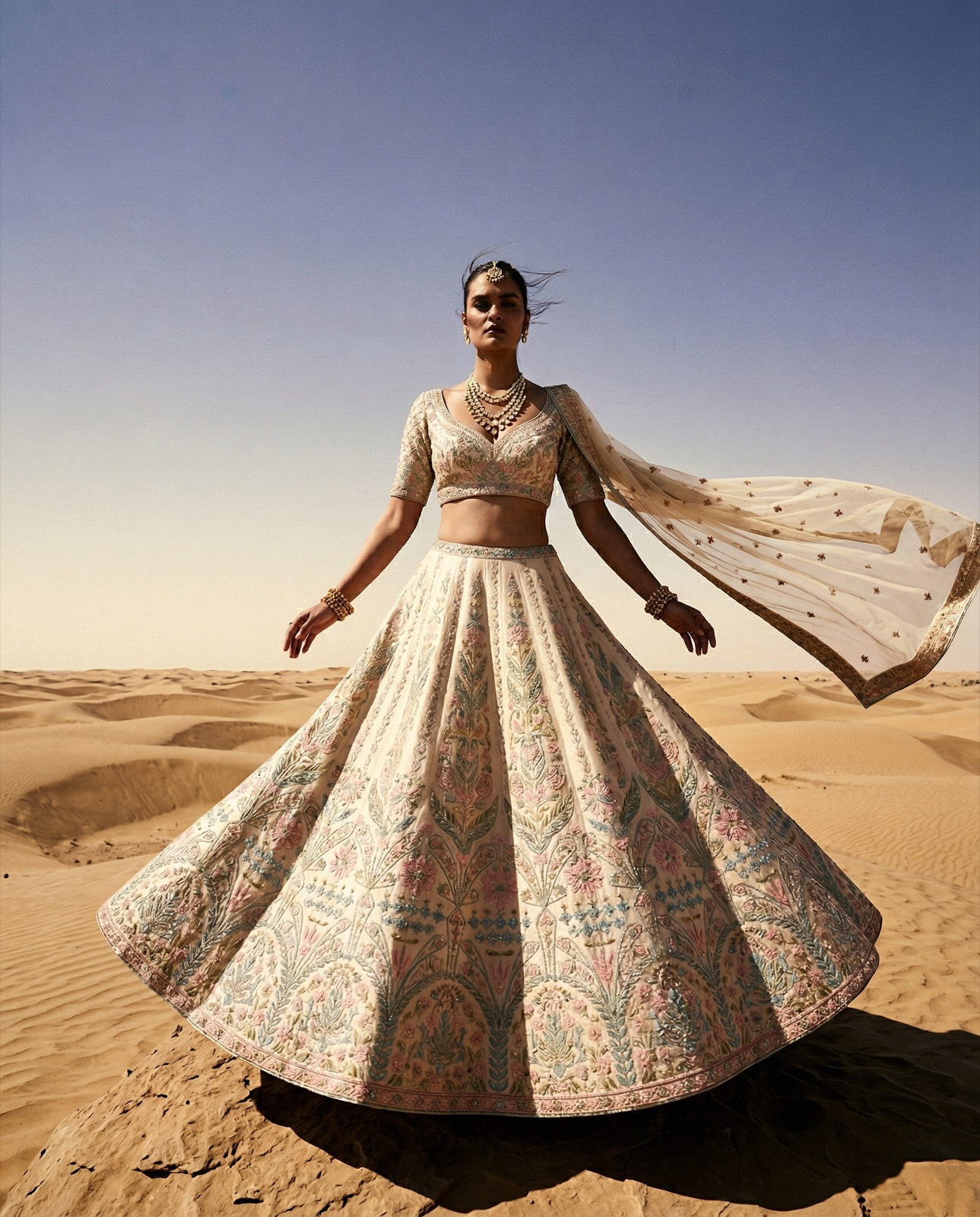
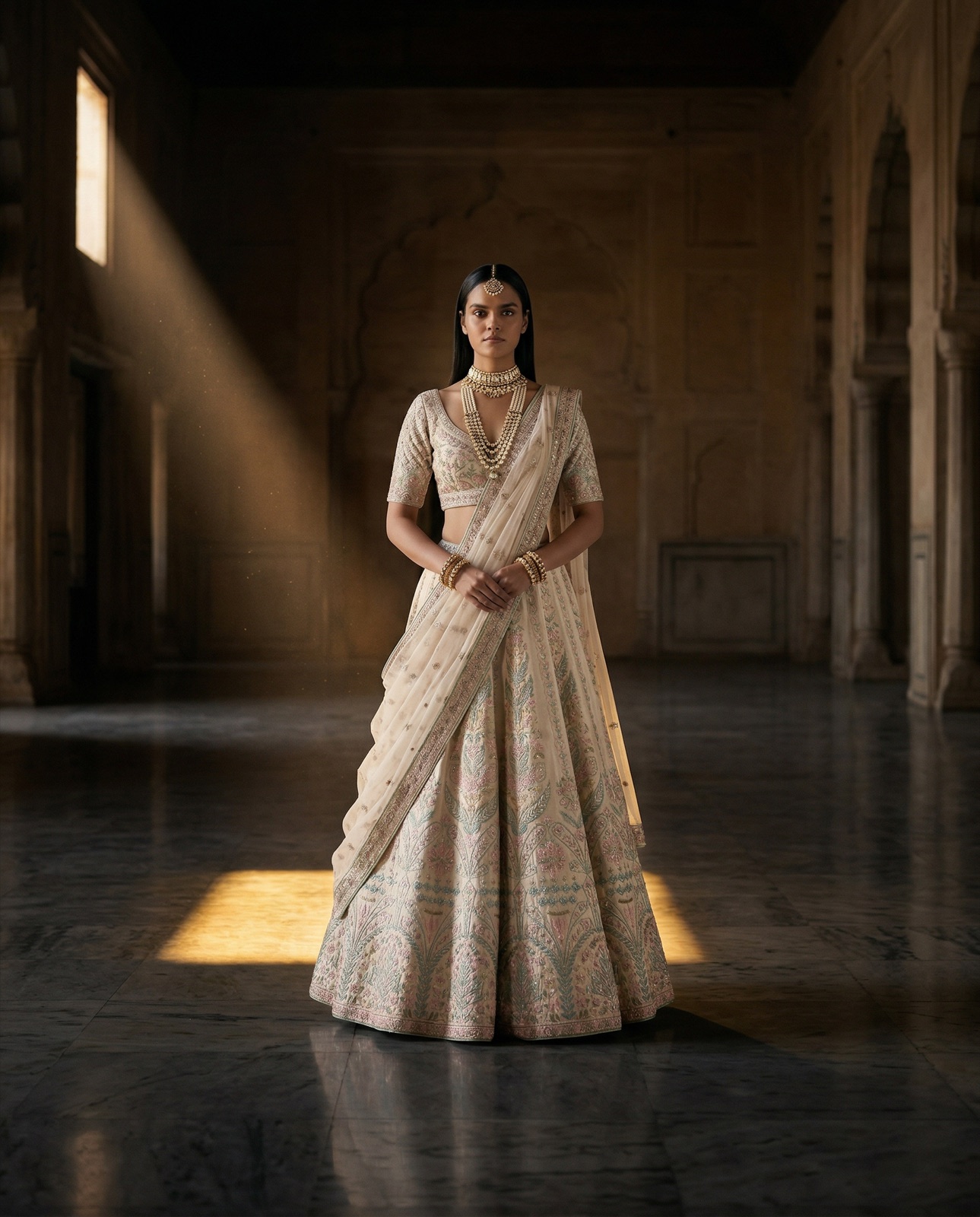
Three frames. One brand spine. Texture preserved, palette restricted, gesture observed — produced at editorial register.

Editorial studio,
volume DTC, and the third path

The four production paths available to a premium sustainable brand running a 60–120 SKU collection cadence are not interchangeable, and the choice has direct consequences on annual photography cost, calendar predictability, and brand-spine fidelity. The named-editorial-photographer path — the Mario Sorrenti, Davide Sorrenti, Petra Collins, Tyler Mitchell, Pari Dukovic tier — runs $15,000 to $40,000 in pure photographer day rate. Add studio, art director, stylist, prop house pull, location, talent at editorial-tier representation, and the assistant team, and a single full-quality editorial day lands between $35,000 and $80,000 before any overrun. The output is eight to fifteen brand-defining frames. For a 60-SKU collection that needs 80 to 160 editorial-register frames across lookbook, PDP, and campaign use, this path lands at $180,000 to $450,000 across four to eight shoot days and six to ten weeks of calendar.

The high-end commercial editorial path — second-tier editorial photographers, $8,000 to $15,000 per day, $25,000 to $45,000 per shoot day all-in — is what most $10M–$30M sustainable brands have been buying for the last decade. Same register at modest reduction in pedigree, $80,000 to $180,000 per collection across three to five days and four to six weeks. The volume DTC path — Meta-creative-tier studios at $3,000 to $6,000 per day, $8,000 to $18,000 all-in — produces 40 to 80 frames per day but at a register that breaks the brand within three campaigns. The math closes on cost-per-asset but the brand-spine drift is the hidden cost.

The fourth path — editorial AI photography registered to the brand's spine at production — produces 80 to 200 frames per month at editorial register on a seven-to-fourteen-day cycle. Collection-spike for a single 80–160-frame collection runs $25,000 to $40,000. Quarterly retainer for 60–120 frames per month runs $35,000 to $65,000. Annual master at portfolio scale runs $65,000 to $120,000 per month. Cost-per-asset closes between $150 and $400 against $1,200 to $4,500 in the studio paths. Register is benchmarked against the reference editorial set on every delivery — locked at the spine layer.

The argument is not that editorial studios should be replaced. Brands at $30M-plus often run a hybrid — one or two editorial campaign shoots a year with the named photographer for brand-defining imagery on .com hero, in press, and in wholesale decks, plus the editorial AI studio handling 90% of catalog, PDP, lookbook, and paid-media adaptation work in between. Where the math really closes is for the $5M–$20M brand still defining itself — those brands need the editorial register at every touchpoint and can not pay for two full editorial shoot days a quarter. The fourth path is what lets them ship at register while preserving capital for the brand-defining campaign moment. The AI photoshoot vs studio cost breakdown opens the same numbers across other vertical contexts.
One register,
three category worlds

The editorial register is the shared discipline. The brand-spine specifications change across categories. Slow fashion, natural beauty, and craft-heritage home each register against a different reference set and require different brand-spine variables locked at the production layer. Each gets its own forty-to-sixty-page spine and its own benchmark voice frames. The production system underneath stays consistent.

01

Slow fashion · Toast · Christy Dawn

Soft side-light from a believable window, neutral gesture, restricted earth-tone palette, untreated linen scrim or hand-trowelled plaster backdrop, preserved fabric texture, models 35–55. Reference set: Toast, Eileen Fisher, Christy Dawn, Apiece Apart, Cuyana, Maggie Marilyn, Mara Hoffman.

02

Natural beauty · Aesop · Le Labo

Apothecary framing, brutalist concrete or weathered paper backdrop, single product on negative space, single directional key, restricted amber-and-green palette, preserved glaze and label embossing. Reference set: Aesop, Pai, Le Labo, Susanne Kaufmann, Vintner's Daughter, Tata Harper, Costa Brazil.

03

Craft-heritage home · David Harber · Toogood

Architectural depth, single object on weathered surface, gallery framing with 60%+ negative space, golden-hour outdoor or museum-light interior, preserved material patina. Reference set: David Harber, Toast Living, Toogood London, Loewe Foundation, Vitsoe, Dieter Rams archives.

Three production shapes
for sustainable luxury

The premium sustainable category does not run on a single engagement shape. Brands at different revenue tiers and collection cadences need different production rhythms, and the right shape depends on whether the brand is running one defining annual collection or four quarterly drops with continuous .com refresh. Three shapes cover the category.

Collection-spike engagement is the entry point for brands running one to two collections per year — Christy Dawn-style botanical-dye seasonal drops, Maggie Marilyn-style hero-collection launches, Mara Hoffman-style limited capsule moments. The shape is a single twelve-to-sixteen-week production block back from launch date. T-minus-twelve weeks the brand-spine ingestion opens. T-minus-ten the voice-frame benchmark is approved. T-minus-seven the collection samples ship to reference capture. T-minus-five the PDP hero pack ships. T-minus-three the lookbook and editorial frames ship. T-minus-one the campaign adaptations and paid-media cuts ship. Launch the .com, retail, wholesale, and press kit pack live simultaneously. The collection-spike covers 80 to 160 frames across the lookbook, PDP, campaign, and adaptation work at $25,000–$40,000 all-in.

Quarterly retainer is the steady-state engagement for brands running four-to-eight collection drops per year against a continuous .com and email creative cadence — Toast-style monthly seasonal refresh, Cuyana-style quarterly capsule rhythm, Apiece Apart-style summer-fall-winter-spring rotation. The shape locks 60 to 120 editorial-register frames per month against a rolling six-week production cycle. Each month two collections are usually in flight — one in lookbook delivery, one in PDP delivery, with adaptation work shipping continuously. Quarterly retainer runs $35,000 to $65,000 per month and is the right shape for brands at $8M–$25M ARR with one in-house photo producer and an outsourced production studio relationship to maintain.

Annual master engagement is for portfolio-scale operations and multi-brand sustainable holding companies — Eileen Fisher's full catalog cadence, Loewe Foundation's editorial program, or a sustainable family office running three or four brands at the same register. The shape locks 200 to 500 editorial-register frames per month across multiple collections, campaign cross-cuts, .com refresh, wholesale and press kit packs, and ongoing email and paid-media adaptations. Annual master runs $65,000 to $120,000 per month with a dedicated production lead, render specialist, and finisher locked for the engagement duration — the equivalent of the multi-vendor sprawl covered in multi-brand photography vendor consolidation, but in the premium sustainable register.

Six drifts that
break the brand

Editorial register is a discipline that drifts when it is not actively defended. Six failure modes are the common ways production drifts away from the locked spine, and each has a specific prevention. Naming them is the difference between a production system that holds the brand for three years and one that breaks the brand inside six months.

The first drift is volume drift. The key light gets progressively brighter from frame thirty onward, the shadow side gets filled, f/2.8 narrows toward f/8, the lookbook starts reading more like Vuori than like Toast. Prevention: the brand-spine locks key-light direction, intensity range, and shadow-side preservation explicitly. Every delivery is benchmarked against the voice-frame set on these three variables before any other review.

The second drift is colour drift. The brand operates a four-to-six colour palette and the production system slowly opens it to eight, then ten, then full spectrum. Prevention: the palette is locked in Pantone and sRGB hex codes at brand-spine ingestion. A do-not-render extension list captures colours that look adjacent to brand colour but are not in the palette — the dusty rose that almost matches the brand's pink but is half a step warm, the olive that is half a step cool of the brand's olive. The production system reviews every delivery for palette drift at the pixel level. Drifts fail before delivery.

The third drift is posture drift. Models start neutral and gradually smile, look at the camera, engage with the audience. The Toast register slowly becomes the Athleta register. Prevention: the brand-spine locks model gesture explicitly — reading, observing, walking away from camera, looking out a window. Smiling and audience engagement are on the do-not-render list. The four-to-eight voice frames the brand approved at ingestion all show the locked gesture register, and every delivery is benchmarked against them.

The fourth drift is retouching drift. Texture is gradually flattened, skin gradually smoothed, fabric wrinkles gradually removed in the name of "polish." Three campaigns in, the brand starts looking like a mass-DTC competitor. Prevention: the brand-spine locks the texture-preservation contract explicitly. Weave variation, hand-stitch dimension, hand-embroidery raised relief, leather grain, ceramic glaze crackle, natural-fibre slubs, skin micro-texture, hair flyaways, fabric wrinkle — preserved. The skin-smoothing default that ships with volume DTC pipelines is disabled at the system layer. The texture-preserving discipline is a daily review check, not a periodic audit.

The fifth drift is backdrop drift. The untreated cream paper warmth gets colour-corrected toward bleached white in PIM ingestion or by an in-house retoucher trying to "clean up" the imagery for retail wholesale. Prevention: the backdrop and surface library is locked into the spine with explicit Pantone and sRGB values, and wholesale and press kit decks ship with the same backdrop register as .com and lookbook.

The sixth drift is model identity drift. The locked model identities age out, a new face is substituted, the brand recognition that compounded across three years of consistent imagery collapses in a single quarter. Prevention: model identity is contractual at the engagement layer. New model identities require a formal spine update with the founder's sign-off — not a quiet production-floor substitution. When a model identity does need to evolve, it is done with a documented transition arc across three to four collection cycles, not in one campaign drop. This same casting discipline runs through the on-model photography at scale framework where catalog volume meets brand-identity fidelity.

The category map
for sustainable luxury

The premium sustainable category is the most underserved segment in the AI product photography conversation in 2026, and also the segment with the highest LTV-per-customer and the strictest brand-spine requirements. The conversation has been dominated by volume DTC, marketplace seller, and CPG retail prep — categories where the production discipline is registered to scroll-stopping pop rather than to slow editorial register. Most production studios in the AI category default to settings that break exactly the brands that have the most to gain from getting the photography economics right.

Editorial register is what justifies a $295 hand-loomed linen shift, a $145 organic-cotton sleep shirt, an $89 small-batch botanical serum, a $2,400 craft-heritage bronze sculpture. Strip the register and the price point becomes arbitrary — the customer is paying a brand premium against an indistinct visual world. Keep the register and the price point reads as the natural consequence of craft, considered design, and editorial taste.

The argument for editorial AI photography in sustainable luxury is not about replacing photoshoots. It is about making the editorial register economically possible at the volume a 60-SKU-per-collection cadence demands. The $20,000–$40,000 editorial studio day produces eight to fifteen frames. The math does not close on the editorial studio path for any brand under $50M in annual revenue, which is most of the premium sustainable category. The best AI product photography agency for DTC brands overview opens the wider landscape — premium sustainable is the segment this article is engineered for. For brands considering the move, the practical step is the brand-spine ingestion session itself — eight hours that produce the forty-to-sixty-page signed artifact that becomes the production contract for everything that follows.

Frequently asked
questions

What is editorial AI photography for sustainable brands?

Editorial AI photography is product imagery produced to the visual register of editorial titles like Cereal, Kinfolk, Apartamento, and Vogue Living rather than the visual register of Meta-feed performance creative. The shorthand is slower, quieter, and more observed — single key light from a believable window direction, negative space carrying the composition, models in neutral posture, fabric and hand-craft texture preserved rather than retouched flat, restricted four-to-six color discipline per collection, untreated-paper backdrops rather than bleached studio white. For premium sustainable brands, this register is what justifies the price point. Volume DTC photography registered to scroll-stopping pop breaks the brand within three campaigns. Editorial AI photography is the production system that holds that register at volume.

How is editorial AI photography different from volume DTC photography?

Volume DTC photography defaults to high-key fill light, full-spectrum saturation, three-quarter smile framing, mid-day brightness, retouched-flat fabric, and bleached studio white — every variable optimised for attention capture on a Meta feed. Editorial photography inverts every one of those defaults. Single directional key, restricted palette, neutral gesture, soft observed light, preserved texture, untreated paper. The two systems are not interchangeable. A production studio registered to volume defaults will break an editorial brand within three campaigns even when the underlying generation model is identical, because the brand-spine instructions and reference frames anchor everywhere the system makes a choice. The mechanic that closes the gap is registration discipline — explicit, written, locked at brand-spine ingestion before the first asset opens.

Which sustainable brands run an editorial visual register?

In slow fashion the canonical examples are Toast, Eileen Fisher, Christy Dawn, Mara Hoffman, Apiece Apart, Cuyana, and Maggie Marilyn. In luxury minimal The Row, Khaite, Lemaire, and Phoebe Philo's Phoebe Philo carry the register. In natural beauty Aesop, Pai, Le Labo, Susanne Kaufmann, and Vintner's Daughter are the reference set. In home and craft Toast Living, Toogood London, Loewe Foundation, and David Harber occupy the same visual world. What every brand in this set shares is that their photography reads like editorial spreads, not like product carousel — long focal lengths, narrow depth, single-key directional light, restricted palette, posture that is observed rather than performed. These are the brands our production discipline registers against.

Why do editorial photography studios cost $20,000 per day?

The named editorial photographers in the slow-fashion and natural-beauty world command day rates between $15,000 and $40,000 because their visual language is unique, recognisable, and difficult to substitute. Add the studio rental, the art director, the stylist, the prop house pull, the natural-light location scout, the model with editorial-tier representation, the retoucher who knows when to leave texture alone, and a single editorial day at full quality lands between $35,000 and $80,000 before talent overruns. The output is eight to fifteen frames at brand-defining register. For a brand running a sixty to one-hundred-twenty SKU collection cadence, that day-rate math closes at roughly $400k–$900k per collection before campaign work begins.

Can AI photography actually produce editorial-register imagery?

Yes, when the production system is registered to editorial conventions at the brand-spine layer. The variable is not the underlying generation model — it is the instruction set, reference frames, and review discipline wrapped around the model. A production studio registered to Meta-feed defaults will produce Meta-feed register imagery regardless of how editorial the brand brief asks for. A studio registered to editorial defaults — single directional key, narrow depth, 85mm to 135mm focal-length character, restricted palette, preserved texture, untreated paper, neutral gesture — produces editorial register output. Our brand-spine ingestion locks these variables explicitly before any asset opens. Each subsequent frame is benchmarked against eight to twelve voice frames the brand has approved as registering correctly.

What does editorial AI photography cost compared to editorial studio work?

For a sub-100-SKU collection running 80–160 editorial-register frames across lookbook, PDP, and campaign use, traditional editorial studio production lands between $180,000 and $450,000 across four to eight shoot days and six to ten weeks of calendar. Our collection-spike engagement at the same volume sits between $25,000 and $40,000 across a seven-to-fourteen-day production cycle. Quarterly retainer for 60–120 frames per month at editorial register runs $35,000 to $65,000 per month. Annual master engagement at portfolio scale — multiple collections, campaign cross-cuts, .com refresh, wholesale and press kit packs — runs $65,000 to $120,000 per month. The output register is benchmarked against the brand's editorial reference set on every delivery.

How do you preserve hand-craft texture in AI photography?

Texture preservation is a registration choice, not a technical limitation. Most production studios retouch fabric, weave irregularity, and hand-stitch detail flat by default because their brand-spine instructions inherited volume DTC retouching defaults — smooth skin, smooth fabric, smooth backdrop, smooth everything. For sustainable brands where the hand-made-ness is the price-point justification, texture must be preserved as a contractual minimum. We lock weave variation, stitch register, hand-embroidery dimensionality, fabric drape, and skin-and-hair micro-texture into the brand-spine and re-check every delivery against the eight-to-twelve voice frames the brand has approved. The texture-preserving discipline is the part most production agencies skip because it costs production time.

Can editorial AI photography handle natural beauty, slow fashion, and luxury home from one production system?

Yes, because the editorial register is the shared discipline — the brand-spine details change across categories but the underlying register holds. For natural beauty (Aesop, Pai, Le Labo register) we lock apothecary framing, brutalist-concrete or untreated-paper backdrop, single product on negative space, single key. For slow fashion (Toast, Christy Dawn, Apiece Apart register) we lock soft side-light, neutral gesture, restricted earth-tone palette, preserved texture. For luxury home (David Harber, Toast Living, Toogood London register) we lock architectural depth, single object on weathered surface, gallery framing. Each brand gets its own locked spine. The production system underneath stays consistent — only the spine specification changes.

Ready for editorial AI
photography that holds the
brand at volume?

Eight-hour brand-spine ingestion. Editorial register locked at production. Slow, observed imagery at the volume your collection cadence actually needs.