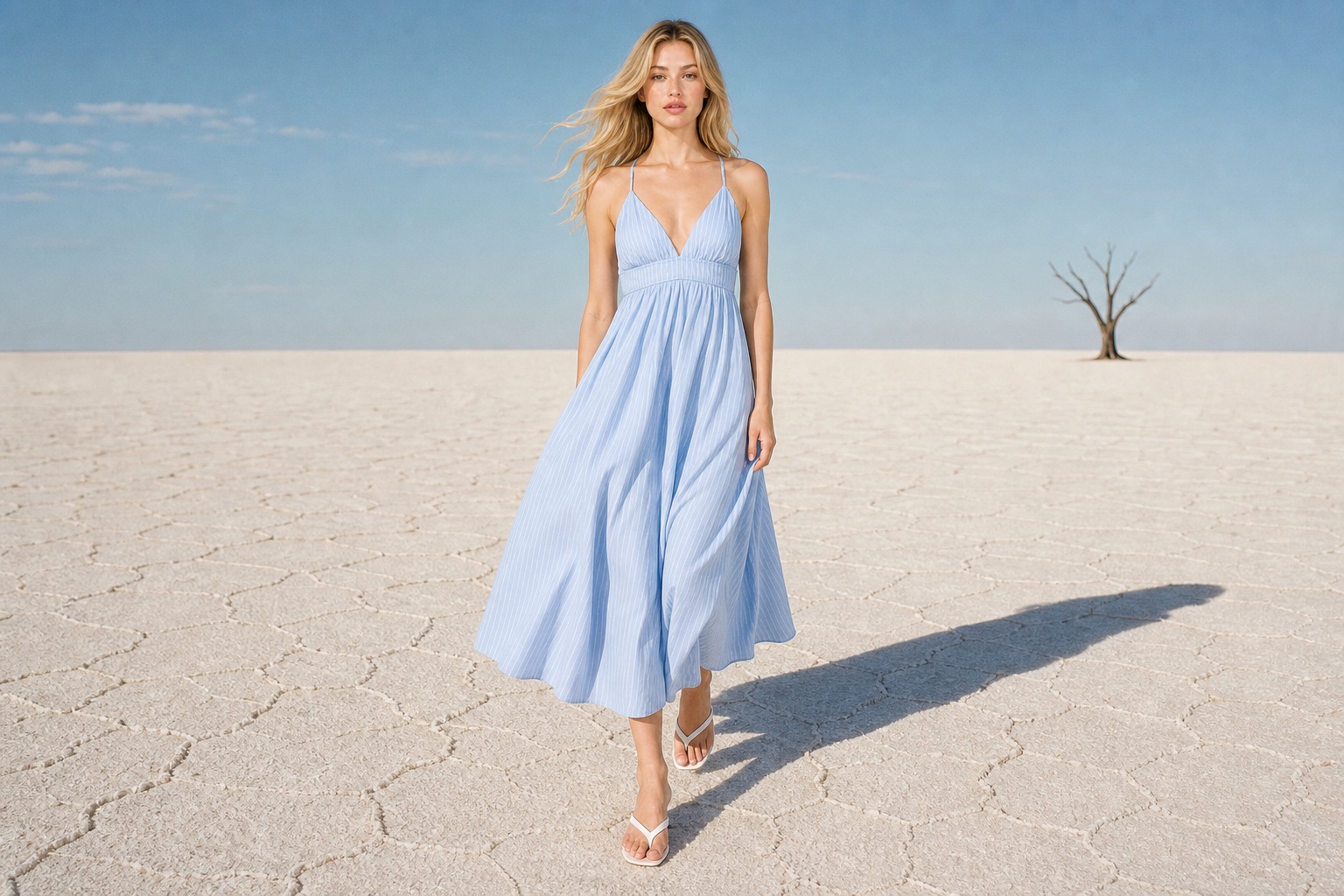
Premium denim brand campaign photography

Premium denim brand campaign photography that reads at the wash provenance, not at the wordmark.

By Abhi Chawla, founder · Last updated: 2026-07-02

This is the campaign contract for the head of brand at a $18M to $95M premium women's denim label at the Re/Done, Mother, Citizens of Humanity, AGOLDE, 3x1, Frame, Khaite, Nili Lotan tier — where the wholesale-deck cover sits next to the Net-a-Porter editorial archive and has to earn that adjacency. Premium denim brand campaign photography is a specific production discipline where the editorial hero pack, the wholesale-deck cover, the lookbook, and the PDP all compose against a wash-provenance library indexed to named mill, named wash, and named finishing curve — locked into the brand spine, held across every drop of the year, and delivered at editorial register without the two-to-three-day $200k-to-$380k named-photographer revival cost.

The register

Contemporary women's editorial frame at the drop-cadence register — produced as premium denim brand campaign photography.

Why the premium denim campaign keeps breaking

It is Tuesday afternoon at 3:47pm at a $34M premium women's denim label in Los Angeles — a Series-B-funded brand at the Re/Done, Mother, AGOLDE, Citizens of Humanity adjacency tier that has been shipping four wholesale drops a year into Net-a-Porter, SSENSE, Bergdorf Goodman, Neiman Marcus, Nordstrom, Bloomingdale's contemporary, Saks, and MATCHESFASHION since 2021. The FW26 line list locks on Friday. The wholesale-deck cover and buyer-portal lookbook for the Net-a-Porter editorial buyer and the SSENSE Editorial team are due fourteen days after line-list lock. A Cass Bird editorial revival quote from a New York agency landed this morning at $268,000 for two shoot days — eleven silhouettes across eighteen usable hero frames, no wholesale-deck cover, no PDP suite, no Klaviyo pack, no OOH. The CFO forwarded the quote back with three questions on scope. The head of brand — a 39-year-old former head of denim design at Citizens of Humanity who left in 2022 to build the brand — has forty-eight hours to solve for a full campaign world at editorial register without spending $260k-$460k across the season the way the last two years have gone.

The pattern is well documented across the premium denim tier. Common Thread Collective's DTC creative benchmark data set from Q1 2026 puts premium women's denim brands at the $18M-$95M ARR band spending 6.4% to 9.1% of net revenue on creative — call it $1.15M to $8.65M per year — with 44% to 58% of that budget consumed by the editorial-tier tentpoles that produce eight-to-fourteen usable hero frames plus a wholesale-deck cover. Andrew Foxwell's DTC creative cost breakdown from March 2026 puts the named-photographer editorial revival at $180k-$380k for two-to-three shoot days across the Craig McDean, David Sims, Steven Meisel, Peter Lindbergh, Mario Sorrenti, Glen Luchford, Colin Dodgson, Charlotte Wales, Cass Bird tier — quotes that arrive line-item-by-line-item and land closer to $260k-$460k after reshoots, licensing extensions, and OOH pack additions. The math worked in 2018. It stopped working in 2023, and the brands who are still absorbing the cost are the ones who have not yet figured out where the campaign actually breaks.

The break is not the editorial hero pack. The editorial hero pack is what the named photographer is genuinely good at, and the eight to fourteen frames a Craig McDean or Charlotte Wales delivers are usually worth the tentpole cost when the brand has the budget to absorb it. The break is everywhere else — the wholesale-deck cover the buyer at Net-a-Porter reviews on a fourteen-day window, the seventy-to-a-hundred-and-forty PDP frames across the drop, the four-to-seven paid-social crops per SKU the growth team needs against Meta's Advantage Plus Shopping placements, the Klaviyo hero refresh the retention team pulls twice a season, the OOH pack for the named-city window frames in New York, Los Angeles, and London during launch week, and the seasonal re-cast for the drop that lands ninety days later. The tentpole covers 6% of the campaign volume and the volume DTC studio downstream covers the rest at the wrong register, and the wholesale-deck cover ships looking like a Shopify product page next to the Net-a-Porter editorial archive because the volume studio composed against its house style, not against the tentpole. Every head of brand in this tier has watched the same failure mode ship at least once. This is the piece that fixes it — and it operates in the same discipline as our production-grade AI product photography contract for DTC brands, applied one tier up into editorial denim.

The four brand tiers this contract maps against

Premium women's denim is not a single tier — it is four adjacent tiers with different fabric contracts, different retail partners, and different editorial registers. Getting the tier right is the first move; every subsequent production decision cascades from it. The 100 Creatives contract maps against four specific tiers, and rejects work outside them because the wash-provenance mechanic only holds if the fabric tier is inside the contract's fidelity envelope.

Tier one is the contemporary editorial premium denim register — Re/Done, Mother Denim, Citizens of Humanity, AGOLDE, Frame, DL1961 flagship, Rag & Bone denim. The retail spine is Net-a-Porter, Nordstrom, Bloomingdale's contemporary denim edit, Saks contemporary. The fabric spine is Cone Mills White Oak archive rope-dye, Kaihara 14oz selvedge, Kuroki 13.75oz selvedge, Turkish ISKO Blue Skin. Retail pricing is $195-$328 women's, $228-$395 men's. The editorial register is Charlotte Wales at Vogue Runway, Colin Dodgson at Style.com, Cass Bird at T Magazine. The customer reads the wash-progression and the crotch-and-thigh honeycombing before she reads the wordmark.

Tier two is the editorial-luxury denim register — 3x1, Khaite denim, Nili Lotan, Simon Miller, Toteme denim, The Row denim, Isabel Marant denim, Bassike denim, Peter Do denim. Retail spine is Bergdorf Goodman, Barneys legacy retail archive footprint at Saks, MATCHESFASHION, MyTheresa. Fabric spine is Kuroki 15oz Japanese selvedge, Candiani Denim archive, Italian Berto Denim, Vidalia Mills selvedge premium. Retail pricing is $325-$625 women's. Editorial register is Craig McDean at T Magazine, Colin Dodgson at AnOther Magazine, Angelo Pennetta at i-D. The customer reads the drape at the seat and the way the hem breaks on the shoe before she reads anything.

Tier three is the Japanese-heritage-inspired premium denim register — A.P.C. Petit Standard, Nudie Denim, Simon Miller Ranger, Naked & Famous Denim, Iron Heart selvedge, Levi's Made & Crafted, Wrangler Blue Bell archive at the contemporary spec. Retail spine is direct-to-consumer plus Barneys-adjacency retail plus the specialist archive footprint — Blue in Green, Self Edge, Rivet & Hide, Denim Refinery. Fabric spine is Kuroki 14-16oz, Kaihara 15oz, Nihon Menpu 15oz, Vidalia Mills selvedge, Cone Mills White Oak deadstock. Retail pricing is $228-$495. Editorial register is Daniel Riera at Highsnobiety, Angelo Pennetta at Grailed Editorial, Colin Dodgson at Cool Hunting. The customer reads the loom width, the selvedge line, and the indigo fade curve.

Tier four is the size-inclusive-and-body-positive premium denim register — Good American, Warp + Weft, Universal Standard denim, Levi's Levi's Curve, MOTHER Petites, Mott & Bow curve. Retail spine is direct-to-consumer plus Nordstrom curve plus Anthropologie contemporary plus specialist size-inclusive retail. Fabric spine is Turkish ISKO Blue Skin at 12-14oz for stretch-recovery, Candiani stretch-selvedge, Cone Mills stretch archive. Retail pricing is $128-$248. Editorial register is contemporary-editorial with the size-inclusive casting mandate — the roster covers cup A through H, rise short through tall, size 24 through 32 waist inclusive of curve blocks and petite blocks. The customer reads the fit-at-body-shape and the rise honesty before she reads the wash.

The 100 Creatives contract explicitly does not map against the Levi's Vintage Clothing, RRL, or Wrangler Blue Bell heritage-workwear register — that lives inside the heritage-Americana wholesale-deck playbook and against the Alec Soth, Bryan Schutmaat, Jamie Hawkesworth editorial register. Nor does it map against the Diesel, True Religion, Hollister volume-mall denim register — the wash-provenance mechanic does not add contract value against a $58-$98 retail price point where the buyer reads the wordmark first. This contract is for premium women's denim at the four tiers above where the wash and the drape do the selling. If your brand is one tier down or one tier up, the fit is closer to our denim photography at scale volume-PDP contract or our luxury apparel brand world playbook respectively.
Wash-provenance-as-spine — the only discipline that holds

The mechanic that makes the premium denim campaign hold across the drop is a wash-provenance library indexed to named mill and named wash, held inside a brand-spine document, and enforced across every frame the brand ships. This is not a moodboard. It is a contract. It carries eleven components, each explicit, each verifiable.

Component one is the mill index. Every denim silhouette in the drop is indexed to a named mill and a named base fabric: Cone Mills White Oak archive rope-dye at 13.5oz, Kaihara 14oz right-hand-twill selvedge, Kuroki 13.75oz slub selvedge, Nihon Menpu 15oz uneven-weft, Vidalia Mills selvedge deadstock at 14oz, Turkish ISKO Blue Skin at 12.5oz stretch-selvedge, Italian Candiani heritage archive at 13oz, Berto Denim at 14oz, Tavex Deep Blue Series at 12oz. The mill index is the first line of the fabric spec sheet the campaign is composed against. Every frame is verified against it. The indigo tone in the frame has to match the mill's baseline indigo curve; when it doesn't, the frame is re-composed until it does.

Component two is the wash-progression library. Every silhouette carries a wash-progression map indexed to named wash: rinse (unwashed straight from the mill), one-wash (indigo held near-full, minimal fade), mid-stone (baseline mid-blue with visible whiskering at hip yoke), stone-and-brush (mid-blue with brushed fade at thigh honeycombing), bleach-and-crinkle (a lighter blue with hand-crinkle at the seat and thigh), balayage (subtle vertical fade progression down the leg), paint-splatter (contemporary editorial-only wash for the tentpole frame), hi-lo tuxedo (two-tone editorial-only for the drop-standout piece). The wash-progression library is what the campaign hero, the wholesale-deck cover, and the PDP all render against — same wash, same indigo tone, same whisker geometry, frame to frame. Component three is the whisker geometry lock. The whisker pattern at the hip yoke, the honeycombing at the crotch, the stacking at the ankle — all of these are anatomically indexed to the fit block (skinny / straight / high-rise-90s / low-rise-2000s / wide-leg / barrel / column) and the wash pass. When the frame's whisker geometry does not match the fit block's baseline, the frame is redone. This is the discipline that separates believable premium denim from the cartoon denim that shows up when a volume studio composes against a house-style whisker template.

Component four is the casting frame lock — four to six model identities held across the drop, indexed to fit block and body shape. The roster carries the same faces the customer will see across the campaign hero, the wholesale-deck cover, the lookbook, the PDP, and the Klaviyo hero refresh. Component five is the named-environment register — soft-morning California light against a stucco wall at a Silver Lake bungalow, mid-afternoon studio light through north-facing windows at a Tribeca loft, blue-hour London street light on a Notting Hill terrace, golden-hour Ojai light against a linen curtain, dusk desert light at Joshua Tree. Named environment, named locality, named light. Component six is the named-photographer editorial register — Craig McDean at T Magazine, Colin Dodgson at AnOther Magazine, Charlotte Wales at Vogue Runway, Cass Bird at T Magazine, Angelo Pennetta at i-D, David Sims at Vogue, Steven Meisel at Vogue Italia archive, Peter Lindbergh at Purple Magazine legacy — one register locked for the season. Component seven is the finishing curve — Kodak Portra 400 for the natural-light frames, Ilford HP5 Plus 400 for the black-and-white frames, Fuji 400H for the muted mid-tone frames, Kodak Tri-X 400 for the harder-contrast archive-reference frames. Component eight is the styling vocabulary — named stylist reference at Karla Welch, Kate Young, Camilla Nickerson, Robbie Spencer, Sebastian Kim, Karen Langley, Joe McKenna. Component nine is the composition grammar — hero is 3x4 vertical, wholesale-deck cover is 4x5, PDP is 1x1 for main plus 4x5 for slot 2, paid-social is 1x1 plus 4x5 plus 9x16. Component ten is the palette bank — the season's palette indexed to Pantone reference for the denim indigo range plus the styling-context tones. Component eleven is the composition-against-hero rule — every wholesale-deck cover holds the same frame as the campaign hero, and every PDP main frame holds the same casting and light logic. The brand-spine document is a twenty-to-forty-page working artifact. It sits alongside our apparel brand identity and campaign system document for the label; the campaign spine plugs into the identity system as a season-specific extension.

The gallery

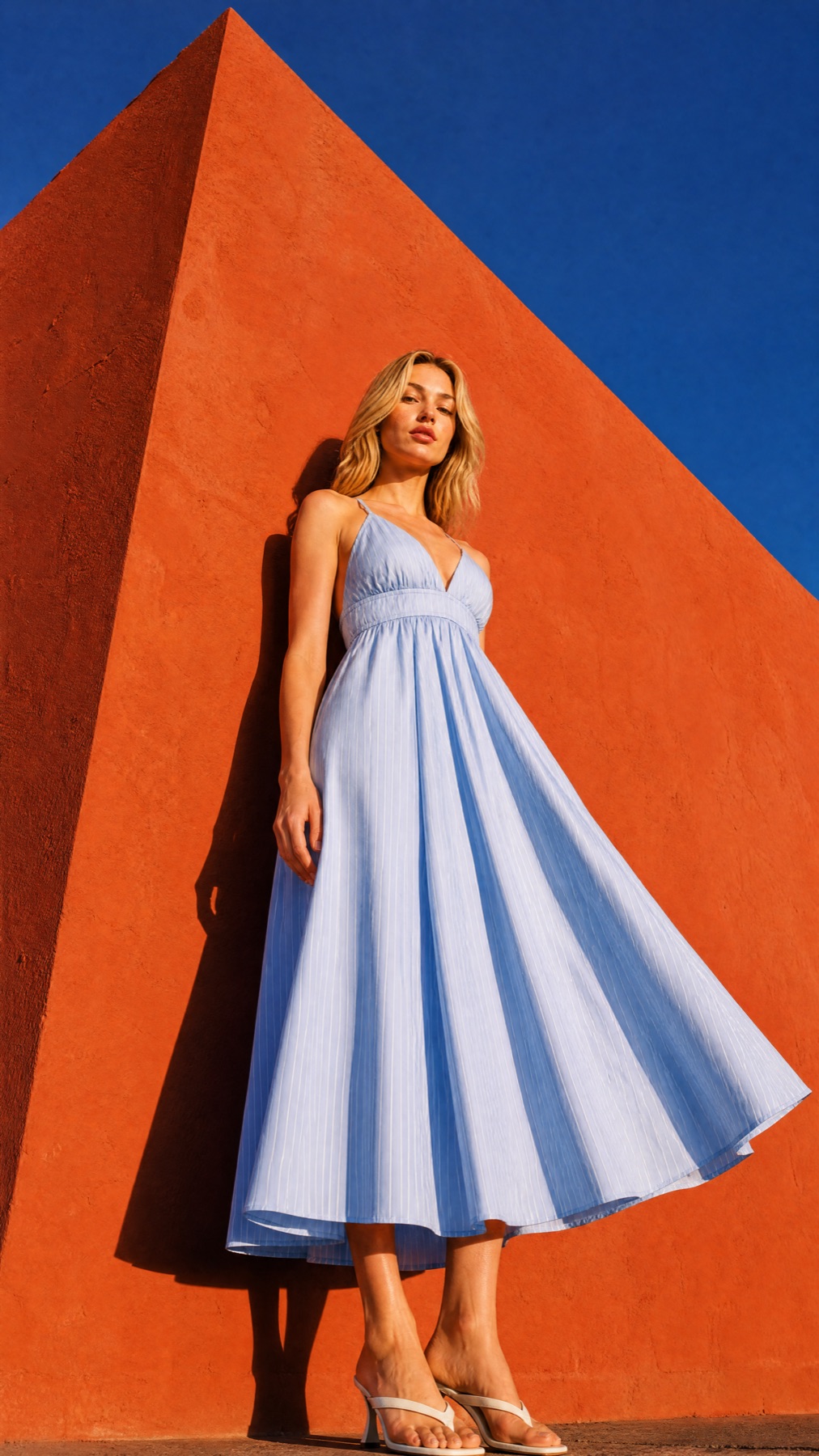
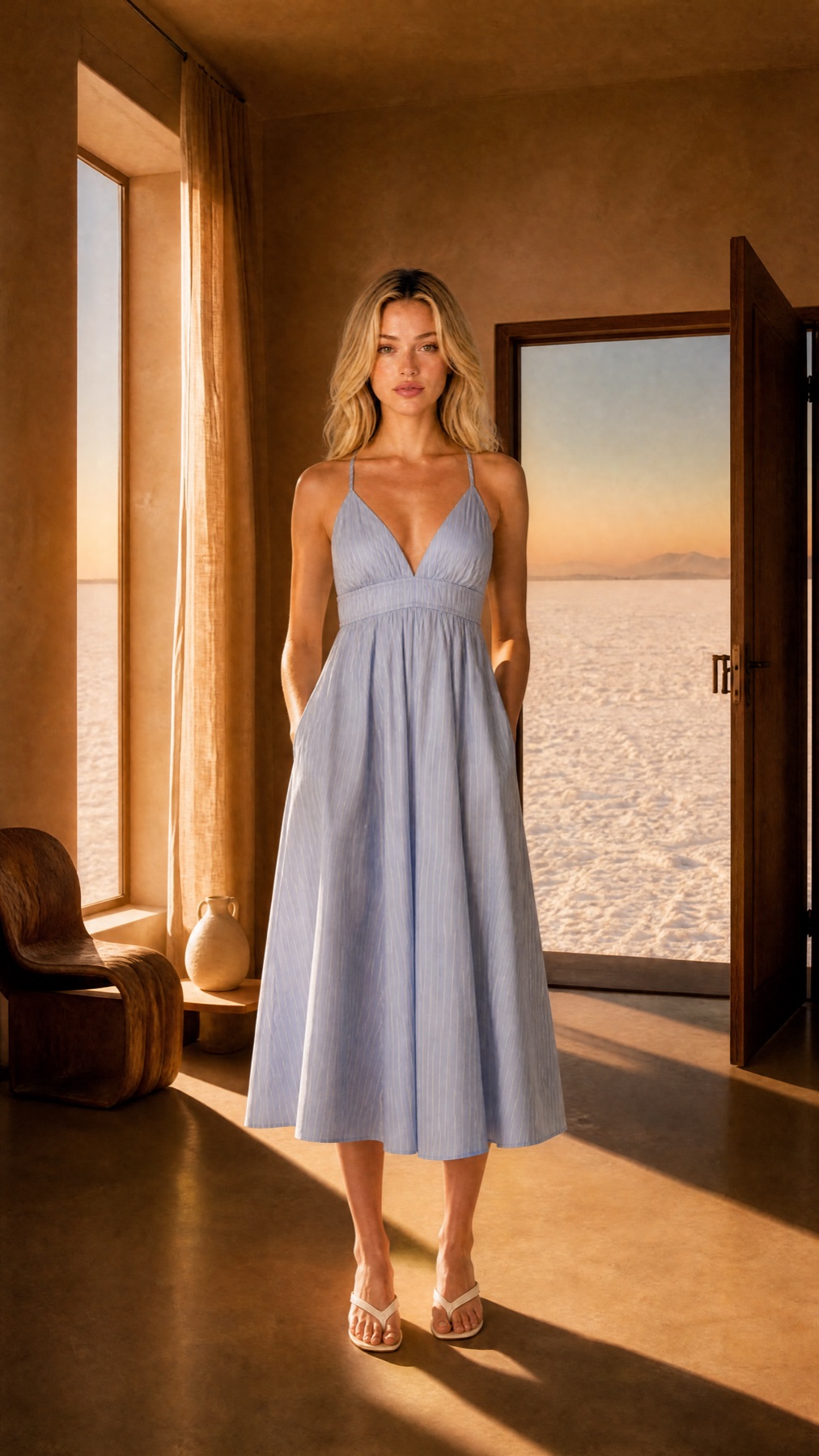
Contemporary editorial denim register — two frames from the drop, one wash-progression map — held against the brand spine.

The six principles of
premium denim campaign photography

Six commitments hold the campaign together across the drop. Any one of them missing and the wholesale-deck cover starts drifting toward the flat-grey-wall volume-PDP register the customer at Net-a-Porter reads as generic.

01

Wash-provenance library is the spine

Every frame composes against a named-mill, named-wash, named-whisker-geometry library. Cone Mills White Oak at rope-dye at 13.5oz reads different from Kuroki 13.75oz slub — the campaign frame has to honor that difference. When the wash-progression library is verifiable and enforced, the wholesale-deck cover for the Net-a-Porter editorial buyer reads as authentic denim rather than as a generic AI-produced blue.

02

Casting roster is locked, not reshuffled

Four to six model identities hold across the drop, indexed to fit block and body shape. Same face on the campaign hero as on the wholesale-deck cover as on the PDP as on the Klaviyo hero. Recognition compounds across the season. Our AI fashion models versus real models discipline is the mechanic underneath — locked identity across the drop, not a fresh cast every wave.

03

Named-environment register at named locality

Silver Lake stucco, Tribeca loft, Notting Hill terrace, Ojai linen, Joshua Tree dusk. Named locality, named light angle, named Kelvin range. The register is what makes the frame feel like the brand's world rather than like a stock backdrop. When the environment reads as a named place, the customer reads the frame as editorial rather than as catalog.

04

Editorial-photographer register is the reference

Craig McDean, Colin Dodgson, Charlotte Wales, Cass Bird, Angelo Pennetta, David Sims. One register locked for the season. This is not about mimicking a specific photograph — it is about locking the light logic, the framing convention, the retouch curve. The wholesale-deck cover has to read as the brand's editorial voice, not as a house-style volume composition.

05

Wholesale-deck cover holds the same frame as the hero

The Net-a-Porter buyer, the SSENSE Editorial team, the Bergdorf Goodman denim edit, the Neiman Marcus buyer, the Nordstrom denim edit, the Bloomingdale's contemporary buyer, the Saks premium buyer, the MATCHESFASHION editorial team, and the MyTheresa denim edit all review the wholesale deck against the campaign hero. The two have to be the same brand at first read. This is the principle the volume DTC studio breaks — house style overrides brand register, and the two ship as different brands.

06

Finishing curve locked at Kodak Portra 400 or Ilford HP5

The retouch curve is the finishing signature. Kodak Portra 400 for the natural-light frames, Ilford HP5 Plus 400 for the black-and-white editorial frames, Fuji 400H for the muted mid-tone. Locked across the drop. Every frame — hero, wholesale cover, PDP, Klaviyo, OOH — carries the same finishing curve. This is what makes the frames feel like they came out of the same campaign rather than out of six different pipelines.

Named-photographer revival vs volume DTC studio vs the wash-spine contract

Three tiers of production compete for the premium denim campaign budget. Each has a distinct cost structure, a distinct output volume, and a distinct failure mode. The head of brand's job is to route each part of the campaign to the tier that actually serves it — and to reject the tier that quietly ships wrong. Numbers below are consistent with Andrew Foxwell's DTC creative cost breakdown from Q1 2026 and the Common Thread Collective benchmark set for the premium women's denim $18M-$95M ARR band.

01

Named-photographer revival

$180k-$380k for two-to-three shoot days at the Craig McDean, David Sims, Charlotte Wales, Cass Bird tier. Eight to fourteen usable hero frames plus the wholesale-deck cover. Does not cover PDP suite, paid-social crops, Klaviyo pack, OOH, or seasonal re-cast. Per-usable-frame cost: $13,000-$27,000. Runs once every eighteen to thirty-six months as the tentpole. Not designed to hold the drop-by-drop cadence.

02

Volume DTC studio

$45k-$95k per drop for eighty-to-one-hundred-and-sixty frames at the house-style composition. Fast turnaround. Covers PDP suite, some paid-social, minimal Klaviyo. Per-usable-frame cost: $340-$1,180. Failure mode: composes against house style rather than against the brand spine, and the wholesale-deck cover reads flat-grey-wall next to the Net-a-Porter editorial archive. Common Thread Collective's Q1 2026 benchmark data flags this as the primary creative-cost inefficiency at the premium denim tier.

03

Wash-spine contract at 100 Creatives

$58k-$102k for six-to-nine weeks of production per drop. Brand-spine document plus twelve editorial hero frames plus wholesale-deck cover plus forty-eight-to-ninety-six PDP frames plus four-to-seven paid-social crops per SKU plus Klaviyo hero pack plus OOH pack plus seasonal re-cast pre-loaded. Per-usable-frame cost: $210-$560. Composes against the brand spine, not against a house style. Holds against the named-photographer tentpole when the brand runs one every eighteen-to-thirty-six months.

Six to nine weeks from brief to wholesale-deck-live

The sprint runs against the brand's line-list lock date. Six weeks is the tight window when the wash-provenance library and the casting roster are already documented from a prior season. Nine weeks is the expanded window when the brand is running the wash-spine contract for the first time and the brand-spine document is being authored from scratch.

Week one is the brand-spine document. Wash-provenance library indexed to mill and to wash. Casting roster lock at four to six named identities across fit block and body shape. Named-environment register with named locality, named Kelvin range, named light angle. Palette bank at Pantone reference. Composition grammar per placement. Finishing curve. Styling vocabulary. This is the twenty-to-forty-page working artifact the entire campaign composes against for the rest of the sprint — and for every subsequent drop of the year. This document does the work our apparel brand identity and campaign system playbook describes as the identity contract, specialized for the drop.

Weeks two and three are casting and light-logic lock. The roster is finalized against the fit blocks. The named-environment register is mapped to the season's tentpole locality. The light logic is composed and rendered against reference frames. The named-photographer editorial register is locked — Craig McDean, Charlotte Wales, Cass Bird, or Colin Dodgson — and the season's finishing curve is chosen. By the end of week three, the campaign has a spine document, a locked roster, a locked light logic, and a locked editorial register.

Weeks four and five are wave one — the editorial hero pack and the wholesale-deck cover. Eight to twelve usable hero frames, composed against the spine, produced against the locked light logic and locked roster. Wholesale-deck cover produced in the same session as the hero, holding the same frame. This is what the Net-a-Porter editorial buyer, the SSENSE Editorial team, and the Bergdorf Goodman denim edit review first — and the fourteen-day buyer-review window opens the day this wave delivers. Wave one determines whether the season books at wholesale.

Weeks six and seven are wave two — the lookbook, the PDP suite, and the paid-social crops. The lookbook extends the hero pack into the drop's full silhouette range. The PDP suite covers forty-eight to ninety-six frames across the SKU count, each carrying the same casting and light logic as the hero. Paid-social crops are produced at 1x1, 4x5, and 9x16 against Meta's Advantage Plus Shopping placement grid. The volume PDP pipeline extends this wave — the wash-provenance library from the spine document is what the volume pipeline calibrates against, and the workflow is the one our denim photography at scale contract describes.

Weeks eight and nine are Klaviyo refresh, OOH pack, and partner-portal QC. The Klaviyo hero refresh carries two versions of the campaign hero pre-loaded for the launch send and the mid-drop re-engagement send. The OOH pack covers New York, Los Angeles, and London named-city window frames. Partner-portal QC runs the wholesale-deck cover against the Net-a-Porter editorial 3x4 spec, the SSENSE 4x5 spec, the Bergdorf brand-book register, the Neiman Marcus denim edit 4x5, the Nordstrom denim edit spec, the Bloomingdale's contemporary buyer spec, the Saks premium spec, the MATCHESFASHION editorial spec, and the MyTheresa denim edit spec. Every partner portal gets its frame set held against the same spine document — no bespoke re-composition per portal. The sprint delivers a fourteen-day buyer-review window at wave-one and lands the full drop live at week nine.

What the wash-spine contract replaces

The wash-spine contract does not replace the tentpole named-photographer editorial revival — the eighteen-to-thirty-six-month Craig McDean or Charlotte Wales campaign that produces the brand's editorial signature. That tentpole remains, and the wash-spine contract runs against it, holding the register the tentpole established across every drop in between. What the wash-spine contract replaces is the drop-by-drop volume DTC studio work that was quietly shipping at the wrong register and eroding the brand equity the tentpole built.

Concretely: the $45k-$95k volume studio per-drop cost is replaced by the $58k-$102k wash-spine contract, and the deliverable expands from eighty-to-one-hundred-and-sixty flat-grey-wall PDP frames to twelve editorial hero frames plus wholesale-deck cover plus forty-eight-to-ninety-six on-spine PDP frames plus paid-social crops plus Klaviyo pack plus OOH pack plus seasonal re-cast. The per-usable-frame cost drops from $340-$1,180 into $210-$560, and the register lifts from house-style volume PDP to editorial-tier composition against the brand spine. Andrew Foxwell's DTC creative benchmark reads this as the primary cost-efficiency move in the premium women's denim tier in 2026, and the WGSN denim trend reports for the fall/winter 2026 season put the wash-provenance-as-spine mechanic at the center of the premium women's denim campaign shift.

What it also replaces is the wholesale-deck cover misfit that has been the quiet churn driver at the premium denim tier. When the wholesale-deck cover reads flat-grey-wall next to the Net-a-Porter editorial archive, the buyer's read of the brand shifts one tier down. Repeated over two seasons, the wholesale slot narrows or moves. The wash-spine contract ships the wholesale-deck cover at the same register as the campaign hero, and the buyer's read of the brand holds at the tier the brand actually sits at. The mechanic overlaps with our wholesale lookbook and linesheet imagery contract for the wholesale-deck construction, and with our fashion lifestyle campaign imagery playbook for the feed-depth lifestyle pack that runs downstream of the campaign.

For brands running an in-house creative team of two-to-eight people, the wash-spine contract is what the team plugs into. The brand-spine document is authored jointly with the head of brand in week one; the roster and light logic are locked in weeks two-to-three with the head of brand's sign-off; the head of brand approves wave-one hero pack and wholesale-deck cover before it goes to the buyer at Net-a-Porter or SSENSE. The team's editorial voice is preserved, and the production muscle to hold the register across the seventy-to-a-hundred-and-forty-frame drop is added. Whether the contract runs against a $200k-$380k tentpole or as the standalone campaign engine, the mechanic is the same. The customer at Net-a-Porter reads the brand as itself — season after season, drop after drop, at the register the brand claimed when it named itself premium denim. The comparison to volume-PDP-only pipelines is covered in our AI fashion photography versus traditional economics walk, and the campaign layer at the tier above sits inside our AI fashion photography flagship.

Frequently asked
questions

What is premium denim brand campaign photography?

Premium denim brand campaign photography is a specific production discipline for women's premium denim labels at the Re/Done, Mother, Citizens of Humanity, AGOLDE, 3x1, Frame, Khaite, Nili Lotan tier — where the campaign hero, the wholesale-deck cover, the lookbook, and the PDP all read at the wash provenance rather than at the wordmark. The core mechanic is a wash-provenance library indexed to named mill (Cone Mills White Oak archive, Kaihara 14oz-16oz, Kuroki 13.75oz selvedge, Nihon Menpu 15oz), named wash (rinse / one-wash / mid-stone / bleach-and-crinkle / hand-sand-and-brush / balayage), and named finishing (Ilford HP5 or Kodak Portra 400 retouch curve) held across every frame in the drop.

How is this different from volume denim PDP photography?

Volume denim PDP photography optimizes for wash accuracy and whiskering rendered correctly at product-page scale — the mechanic covered in our denim-photography-at-scale playbook. Premium denim campaign photography operates one tier up: editorial hero pack, wholesale-deck cover for the Net-a-Porter buyer at the SSENSE, Bergdorf, Neiman Marcus denim edit, casting frame locked at named-photographer editorial register (Craig McDean, Colin Dodgson, Charlotte Wales, Cass Bird), and a wash-provenance-as-spine document that carries the brand across every drop of the year rather than SKU-by-SKU. The two disciplines feed each other. The wash library from the editorial campaign is what the volume PDP pipeline is calibrated against.

Can AI-produced denim imagery hold at the Vogue Runway or T Magazine register?

Yes, when produced with editorial discipline. The technical requirement is fabric fidelity — selvedge line at the outseam, indigo tone across the wash progression, whisker geometry at the hip yoke, crotch-and-thigh honeycombing rendered at anatomically correct compression — and named-photographer register discipline held across the hero pack. We treat the wash-progression accuracy as pass-fail. If the mid-stone reads flat or the whiskering reads painted-on, the frame does not ship. The editorial-register discipline layers on top: locked light logic, named-environment vocabulary, casting frame at editorial posture, finishing at Kodak Portra 400 or Ilford HP5 retouch curve. The result reads at the same tier the Net-a-Porter editorial buyer expects.

What does a premium denim campaign shoot traditionally cost?

A named-photographer editorial revival for a premium women's denim label at the Craig McDean, David Sims, Peter Lindbergh, Mario Sorrenti tier runs $180,000 to $380,000 for two to three shoot days, before agency fees and post — pricing consistent with the ranges Andrew Foxwell has published on DTC editorial campaign budgets and with the WGSN denim brand-tier benchmark set. That budget covers eight to fourteen usable hero frames plus the wholesale-deck cover; it does not cover the seventy to a hundred and forty PDP frames, the four-to-nine paid-social crops per SKU, the Klaviyo refresh, the OOH pack, or the seasonal re-cast. Once you back out reshoots and post overrun, premium denim brands are commonly spending $260k-$460k per fully-produced season.

What does the 100 Creatives premium denim contract cover?

The premium-denim contract is $58,000 to $102,000 for a fully-produced season: brand-spine document (wash-provenance library, roster, register, palette, composition grammar) as the one-time onboarding effort; eight to twelve editorial hero frames plus wholesale-deck cover; forty-eight to ninety-six PDP frames across the drop; four to seven paid-social crops per SKU; Klaviyo hero pack; OOH pack for named-city window frames; and the seasonal re-cast for the next drop pre-loaded against the same locked roster. Six to nine weeks against the named-photographer $200k-$380k for two-to-three days. The wash-provenance library carries into the volume-PDP pipeline as the accuracy contract that pipeline calibrates against.

How do you handle the wholesale-deck cover for Net-a-Porter, SSENSE, Bergdorf?

The wholesale-deck cover for the Net-a-Porter editorial buyer, the SSENSE Editorial team, the Bergdorf Goodman denim edit, the Neiman Marcus denim buyer, the Nordstrom Denim Edit buyer, the Bloomingdale's contemporary denim edit, the Saks premium denim buyer, the MATCHESFASHION editorial team, and the MyTheresa denim edit is composed against the same frame as the campaign hero — same casting, same light logic, same wash. Named-portal partner spec walks: Net-a-Porter editorial 3x4 plus close-up slot 2 at hem-and-crotch honeycombing plus lifestyle slot 3 at Journal register; SSENSE editorial 4x5 plus one wide plus one construction-detail-at-300%; Bergdorf 3x4 at brand-book register; Neiman denim edit at 4x5 with lifestyle plus flat-lay. The deck ships holding the same visual language the campaign hero holds.

What if we already have a named-photographer editorial from a prior season?

That named-photographer editorial becomes the register lock. We rebuild the brand-spine document from that campaign's frame set — light logic, wash vocabulary, casting frame, styling register, finishing curve — and every subsequent drop composes against that document. The named-photographer campaign runs once every eighteen to thirty-six months at the $200k-$380k tier and produces the tentpole. The 100 Creatives contract runs against that tentpole every drop in between at $58k-$102k, holding the register the tentpole set. This is the pattern we run for brands already established with a Cass Bird or Charlotte Wales editorial — the tentpole holds, the drop-by-drop holds against it, and the wholesale buyer sees the same brand across every season.

Which denim brands and reference tiers does the contract map against?

The premium women's denim campaign contract maps against the Re/Done, Mother Denim, Citizens of Humanity, AGOLDE, 3x1, Frame, Khaite denim, Nili Lotan, Simon Miller, Toteme denim, The Row denim, Isabel Marant denim, Rag & Bone denim, A.P.C. Petit Standard adjacency tier. Fabric tier maps against Cone Mills White Oak archive, Kaihara 14-16oz selvedge, Kuroki 13.75oz selvedge, Nihon Menpu 15oz, Vidalia Mills selvedge, Turkish ISKO Blue Skin, Candiani Denim, Italian Berto Denim, and Tavex Deep Blue Series. Retail tier maps against Net-a-Porter, SSENSE, Bergdorf Goodman, Neiman Marcus, Nordstrom, Bloomingdale's, Saks, MATCHESFASHION, MyTheresa, and Free People premium. The contract does not map against the Levi's Vintage Clothing or RRL heritage-Americana workwear register — that lives in the workwear-and-heritage-Americana playbook.

What is the sprint from brief to wholesale-deck-live?

Six to nine weeks against the brand's line-list lock date. Week one is the brand-spine document — wash-provenance library indexed to mill and to wash, casting roster lock at four to six named model identities, named-environment register, palette, styling vocabulary. Weeks two to three are casting and light-logic lock. Weeks four to five are wave one — editorial hero pack plus wholesale-deck cover. Weeks six to seven are wave two — lookbook plus PDP suite plus paid-social crops. Weeks eight to nine are Klaviyo refresh plus OOH pack plus partner-portal QC against the Net-a-Porter, SSENSE, Bergdorf, Neiman, Nordstrom, Bloomingdale's, Saks spec sheets. The sprint holds against a fourteen-day buyer-review window for the wholesale deck.

Do you protect against the flat-grey-wall volume DTC studio look?

Yes — that is the primary discipline the contract exists to enforce. Volume DTC studios read premium denim as another category to run through the house-style flat-grey-wall composition, and the wholesale-deck cover ships looking like a Shopify product page next to the Net-a-Porter editorial archive. The premium-denim contract composes against the brand-spine document, not against the house style. Every frame is checked against the wash-provenance library, the casting roster, the named-environment register, and the finishing curve. If a frame reads like a generic denim PDP rather than like the brand's editorial voice, it does not ship. The failure mode is well documented in Common Thread Collective's DTC creative benchmark data and covered in our post-failed-AI-vendor-recovery playbook.

Ready to ship the premium denim
campaign at editorial register?

Wash-provenance-as-spine. Wholesale-deck cover that holds the same frame as the campaign hero. Six to nine weeks from brief to wholesale-deck-live. Book a call and we walk your brand spine, your roster, and the drop calendar.