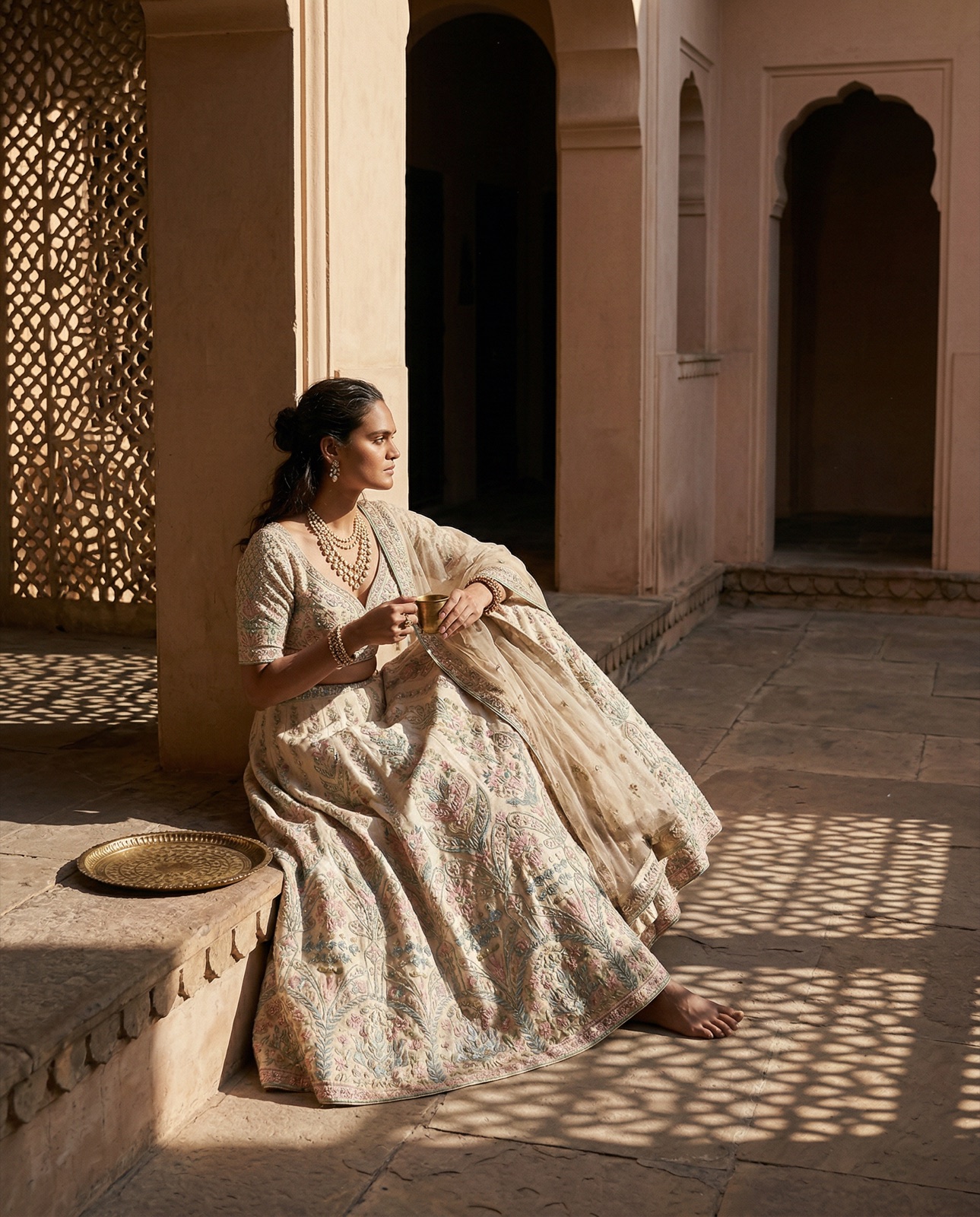
Apparel · feed-depth lifestyle layer

Fashion lifestyle photography that earns the save, not the scroll.

Fashion lifestyle photography is the in-context, real-world imagery that lives between the campaign hero and the product-on-white frame — the customer at the kitchen counter in the linen shirt, the same customer on the gravel path in the coat, the friend group on the studio loft sofa. It is the feed-depth layer that holds the brand world together when the campaign hero has lapped its first week of paid and the next drop is still six weeks away. The campaign sets the price point. The lifestyle layer holds the customer inside it for the months in between. For apparel labels at the three to thirty million revenue band — Reformation, DÔEN, Mara Hoffman, Sézane, Buck Mason, Todd Snyder, Aimé Leon Dore, Frankie Shop, Vuori, ALO Yoga, Ulla Johnson, Rouje — the lifestyle layer is the surface on which the brand world is either held or quietly lost.

By Abhi Chawla, founder · Last updated: 2026-06-10

Brand-world reference

An apparel brand world held inside one model identity — produced as fashion lifestyle photography.

The campaign hero ran out and the feed went thin.

It is the Tuesday after the launch campaign shipped. The campaign hero ran a week of Instagram first-stop and a week of paid prospecting. Save-rate climbed for nine days, plateaued, then slid the moment the drop carousel moved out of primary rotation. By Tuesday the feed is back to product-on-white, repost-from-customers cropped wrong, a behind-the-scenes carousel already lapped, and a press-review screenshot. The brand director opens the social calendar and sees the same row she has seen for three quarters — "lifestyle shoot — TBD". The campaign was the easy part. The eleven weeks before the next drop quietly break the brand.

This is not a creative problem. It is a feed-depth problem dressed up as one. The campaign hero absorbs seventy percent of annual photography budget and gets the attention it pays for. The lifestyle layer that has to carry the feed in the weeks between is the line nobody approves because nobody has a good number for it. A two-day location shoot at the Reformation register quotes at eighty thousand. A four-day at the DÔEN tier quotes at one-eighty. The brand director cuts the line, asks the team to "shoot something organic", and three weeks later the feed is product-on-white again.

The problem the lifestyle layer solves is the gap between attention drops. According to Andrew Foxwell's apparel-vertical operator panels and the Common Thread Collective creative-fatigue audits, save-rate on apparel feeds drops between thirty and sixty percent once the campaign hero exits primary rotation. CAC creeps up over the same window. The customer who saved the campaign post does not re-save the product-on-white. The feed-depth layer holds save-rate flat through the cycle — not by replacing the hero but by filling the eleven weeks it cannot carry alone.

Why the UGC pack, the content creator deal and the “just shoot something organic” ask all break the brand.

The first instinct after the location-shoot quote gets cut is to buy a UGC pack. Forty creators, ninety days, a tracking spreadsheet, a brief template everyone customises on their own. The frames arrive on a rolling basis, processed through forty different phones, colour profiles, model registers and framing instincts. The social manager batches the best into the calendar. The feed gets full. The feed also reads as forty different brands stitched together by someone who was not in the room when the campaign editorial register was set. We have watched a brand director save a ninety-thousand location shoot, spend twenty-six on the UGC pack, and lose three points of save-rate on the same quarter.

The second instinct is to sign a single content-creator deal at a higher tier — one named creator, one season, one register that nominally aligns. This works for the four-to-six weeks the creator is contractually active and evaporates the moment the deal ends. The brand is now hostage to a calendar it does not control. The creator goes on holiday. The creator takes on a competitor deal. The brand director discovers in week seven that the season's lifestyle layer is sitting inside one creator's camera roll and the in-house team cannot ship a single frame without an approval cycle. The dot-com is asking for fresh module imagery. Nothing ships.

The third instinct the in-house team hears most often is "can you just shoot something organic at the weekend?" The designer and the social manager pile into a Sunday at someone's apartment with the new drop, an iPhone 15 Pro and a styling rail. The frames are real. The frames are also lit by ambient afternoon light at a different colour temperature than the campaign hero, framed by someone whose composition language is Stories-first, posted into a feed grid where the editorial register sits next to the named-photographer campaign frame. The eye registers the temperature shift before the customer reads the caption.

All three failure modes have one cause. None are composed against the brand-spine document the campaign hero was built on. The UGC pack does not know what the spine is. The creator has her own house style. The Sunday shoot has no spine to compose against. The fix is not better creators or better iPhones. The fix is treating the lifestyle layer as a production discipline composed against the same spine the hero was built on, on a calendar that aligns to the feed.

The six lifestyle registers that compose the feed-depth contract.

The feed-depth contract begins with the same brand-spine document the campaign hero is composed against and adds the lifestyle registers the campaign hero cannot, by itself, hold. We lock six registers in week one of any new season. Each is a named environment, a defined time of day, a defined light direction, an on-figure styling logic, and a relationship to the season's casting frame. The registers are not interchangeable — each carries a specific job. The customer reading the feed week-by-week is moving across them at the pace of the social calendar, and the contract is what keeps the movement coherent.

The first register is the morning interior — kitchen counter, dining table, hallway mirror — composed in soft directional north-window light, the customer's first hour of the day, a single hero garment as anchor, the season's morning palette. The second is the studio-loft afternoon — apartment, studio, light-filled work environment — cooler overhead light, two to three garments as a layered look, the season's neutral palette. The third is the weekend outdoor — coastline path, garden, market street, urban park — golden-hour directional light, an outerwear layer over the season's hero garment, the warm palette.

The fourth register is the friend-group set piece — dinner table, back garden, gallery opening — warmer ambient evening light, multi-figure framing that puts the season's casting frame against one or two secondary models, the evening palette. The fifth is the next-drop teaser — the brand's editorial signature crop, the locked casting frame, a look from the upcoming drop pre-leaking against the current season's palette. The sixth is the close-detail still — fabric in hand, hand at hem, ring against fabric — composed without a face, the same colour register as the active campaign hero, the texture surface that carries between full-figure frames. Six registers. One locked model identity. One world.

Inside the brand-spine document the registers are tied to a one-page production contract. Every frame is composed against it before it ships. The contract specifies the colour register in Pantone-locked sRGB at under three Delta E drift, the light direction in physical units, the negative-space ratio per register, the on-figure styling logic, the casting-frame identity, and the named environment list. The same contract the luxury apparel campaign tier uses for restraint discipline is here deployed for feed depth — a different surface, the same production mechanic.

01

Lock the casting frame in week one

One season, one customer. The model identity captured against the brand-spine document on day one of the season is the same identity that carries through every lifestyle frame for the next thirteen weeks. The customer reads the feed and recognises the woman before the wordmark loads. Documented further in the AI fashion models versus real models comparison.

02

Compose against the brand spine, not against a prompt

Every lifestyle frame is composed against the same brand-spine document the campaign hero was built on — colour in Pantone-locked sRGB at under three Delta E drift, light direction in physical units, negative-space ratio per register. The prompt-first generic AI service produces a sweater on a model. The spine-first frame produces the brand.

03

Hold the six lifestyle registers as a contract

Morning interior, studio-loft afternoon, weekend outdoor, friend-group set piece, next-drop teaser, close-detail still. The feed-depth contract specifies each register by named environment, time of day, light direction, styling logic and palette. The customer moves across them at the pace of the calendar without the feed reading as a different brand.

04

Ship the sprint on a two-week cadence

Week one: brief lock against the brand-spine document. Week two: composition, review, finishing, DAM ingestion cropped to every channel — Instagram 1:1, 4:5, 9:16, TikTok 9:16, Pinterest 2:3, email hero 600px, dot-com modules. The calendar runs on the feed rather than on a shoot day six weeks out.

05

Treat the next drop as a teaser register, not as a leak

The fifth register pre-leaks the upcoming drop inside the current season's palette and styling logic, locked on the casting frame the customer already recognises. The drop arrives not as a hard cut but as a continuation of the world she has been inside for eleven weeks. Save-rate compounds across the cycle rather than resetting on every drop day.

06

Brief the studio against the social calendar

The two-week sprint is indexed back from the social calendar — Klaviyo send, story sequence, Pinterest pinning, dot-com module refresh, wholesale partner brand-page refresh. The studio ships the frames the calendar already needs. The brand director stops being the producer between drops.

The two-week sprint, indexed back from the social calendar.

The sprint is the operating system of the feed-depth contract. We run it on a fortnightly cadence locked to the social calendar. Every two weeks the brand ships a wave of twenty to forty lifestyle frames across the six registers, cropped to every channel, into the DAM the in-house team works out of — Bynder, Brandfolder, Frontify, Aprimo, Acquia DAM, Cloudinary or the brand's lightweight Notion-plus-Drive stack at the smaller end. The sprint replaces the once-a-season location shoot the brand could not afford and the rolling UGC pack it was reading as twelve different brands.

Week one runs on the brand side. Monday the brand director or in-house art director sends the sprint brief — twenty to forty frame requests, two to four per register, indexed to specific calendar slots over the next two weeks. The brief is one page. It cites the brand-spine document by section, specifies the casting frame, names the environments per frame, and references the campaign hero the lifestyle layer is sitting alongside. Wednesday the studio confirms the composition plan. Friday the in-house team signs off. Four touchpoints and roughly six hours of producer time across the week.

Week two runs on the studio side. Monday through Wednesday the studio composes every frame against the brand-spine document and the sprint brief. Thursday the first pass lands in the DAM. Friday the art director reviews against the spine — colour register, light direction, negative-space ratio, casting identity, named environment — and flags any frame that fails the contract. Friday afternoon the studio finishes the flagged frames. Friday evening the final wave lands cropped to every channel aspect ratio. The brand has the frames it needs for the next fortnight before the weekend.

The cadence has a second-order effect the cost line on the invoice does not show. The in-house team stops being the production team between drops. The designer goes back to designing. The brand director goes back to the brand. The Sunday-afternoon iPhone shoot disappears. The same cadence model is the rhythm we deploy at the brand-world tier for in-house creative teams at fifty-million-plus brands. The sprint scales up. The discipline stays the same.

The three lifestyle-layer paths most apparel brands have already tried.

Tier 1

The freelance location shoot

Eighty to two-hundred-twenty thousand all-in per season — location scout, permits, talent, stylist, glam, photographer, assistants, post, contingency. Two to four shoot days against forty to ninety usable frames. Ships once. Carries four to six weeks of feed at best. Quality is excellent inside the shoot window and disappears outside it. The brand director spends Q3 budgeting and Q4 watching the feed go thin. The math works if the brand has one campaign per year and a flat social cadence. It does not work for the eleven-week gap inside a two-to-four-campaign cycle.

Tier 2

The UGC pack and the content-creator deal

Sixteen to forty-five thousand per quarter for forty creators on rolling delivery, or twenty-five to seventy thousand for a single named-creator season deal. Volume is high. Brand coherence is low. Forty creators produce frames against forty different colour profiles and framing instincts. One named creator produces a coherent season but disappears the moment the deal ends. Per Common Thread Collective's creative-fatigue audits and Andrew Foxwell's apparel-vertical panels, save-rate on UGC-heavy feeds drops faster, not slower, than product-on-white. The customer reads the inconsistency before she reads the caption.

Tier 3

The feed-depth studio contract (us)

Fourteen to thirty-six thousand per month against a two-week sprint cadence shipping eighty to one-hundred-sixty lifestyle frames across the six registers — all composed against the brand-spine document the campaign hero was built on, all cropped to every channel aspect ratio in the in-house DAM. Model identity locks to the season's casting frame. The brand director stops being the producer between drops. The feed reads as one brand for the eleven weeks between campaigns. The location shoot stays for the once-a-year tentpole. The contract holds the season around it.

The math against the annual photography budget.

An apparel brand at the three to thirty million band typically runs an annual photography budget between one-hundred-eighty thousand and one-point-one million fully loaded. Campaign hero shoots absorb sixty to seventy-five percent of that — one-hundred-fifty to seven-hundred-fifty thousand across two to four named-photographer or destination shoots per year. Lookbook production, wholesale-deck covers and dot-com hero refreshes add another twenty to fifteen percent. The remaining ten to fifteen percent is what gets approved for the lifestyle layer that has to carry the feed for nine to fifteen weeks between campaigns. On the cash math, that residual is twenty to one-hundred-twenty thousand per year against a feed asking for thirty to sixty frames every two weeks. The math does not close at any traditional model. This is why the feed goes thin.

The feed-depth studio contract closes the math. The cash line lands at fourteen to thirty-six thousand per month — one-hundred-seventy to four-hundred-thirty thousand per year — against eighty to one-hundred-sixty lifestyle frames per month, all composed against the brand-spine document, all cropped to every channel. The brand director recovers the lifestyle line out of the freelance-shoot budget that was being half-spent and never quite delivering. The campaign hero budget stays intact for the named-photographer destination moments the brand keeps. According to the per-frame economics the studio operates against, the lifestyle layer ships at eighty to one-hundred-eighty dollars per frame versus four-hundred to twelve-hundred on the traditional model.

The second-order economics sit on the in-house team's calendar. The designer who was producing Sunday iPhone shoots gets fifty to seventy hours per quarter back. The brand director juggling creator deals and weather-delayed location shoots gets ten to fifteen hours per week back. The social manager gets the entire next-fortnight calendar visible at the start of every sprint. These hours do not show on the invoice — they show up in the team getting back to the work it was hired to do. Our documented case work with Anita Dongre shows the same calendar dynamic at the bridal-luxury register where lifestyle imagery has to hold across multi-quarter seasons.

What the first three sprints look like when the brand is moving onto the contract.

The first sprint is brand-spine ingestion. We run a four-to-six-hour working session with the brand director, the in-house art director and the social manager — walking the existing campaign hero, the season's casting frame, the colour register in Pantone-locked sRGB, the light direction, the named environments the customer recognises, the negative-space ratio of the campaign hero, the styling logic per register. The output is a forty-page brand-spine document signed by the art director that becomes the production contract for the season. We ship the first twenty lifestyle frames against the spine inside the same two weeks. The brand director sees the first sprint land and recognises the brand on every frame.

The second sprint is rhythm. The Monday-Wednesday-Friday touchpoints become routine. The brand director stops being the producer and starts being the reviewer. The social manager loads the next two weeks of the calendar against the frames that arrived Friday evening. The dot-com module refresh runs against the new lifestyle frames mid-week. The Pinterest pinning calendar opens up because the inventory is finally there. The feed-depth save-rate begins to lift inside three weeks of the contract starting, on the data we have seen at apparel brands operating in this band, supported by the volume-for-Meta diagnosis we documented earlier.

The third sprint is integration. The next-drop teaser register pre-leaks the upcoming drop on the locked casting frame in week three of the cycle. The campaign hero for the next season is being briefed against the same brand-spine document the lifestyle layer is running on, which means the next campaign and the lifestyle layer that follows it are visually continuous from day one. The wholesale partner brand-page refresh runs against the studio's output without back-and-forth. The press editor pulling imagery for a feature pulls from the same DAM the social manager works out of, with the brand spine intact across every frame. The brand is operating as one world.

Inside the broader apparel brand-world practice.

The feed-depth contract is one tier of a broader apparel brand-world practice. The brand-world model for in-house creative teams is the parent document the lifestyle layer outputs from. The luxury apparel campaign tier is the restraint-discipline version at the quiet-luxury register. The apparel brand identity and campaign system is the upstream identity layer the brand-spine document is composed against. The knitwear lookbook and wholesale linesheet pieces are sibling surfaces of the same season; the seasonal drop workflow is the rhythm the sprint cadence indexes against; the AI lookbook photography service ships the lookbook tier; the best AI fashion photography services comparison frames the broader category; and the apparel agency anchor reference sits above the practice.

For the brand director with a feed gone thin and a calendar showing "lifestyle shoot — TBD" three quarters running, the feed-depth contract is the line item that closes the gap. Not a replacement for the campaign hero. Not a competitor to the named photographer the brand keeps for the season's signature moment. It is the surface that holds the brand world together for the eleven weeks the hero is off screen, at a per-frame cost the CFO can model. The campaign signals the price point. The lifestyle layer holds the customer inside it.

Fashion lifestyle photography · frequent questions

What is fashion lifestyle photography?

Fashion lifestyle photography is the in-context, real-world imagery that lives between the campaign hero and the product-on-white frame — the customer at the kitchen counter in the linen shirt, the same customer on the gravel path in the coat, the friend group on the studio loft sofa. It is the feed-depth layer that holds the brand world together when the campaign hero has lapped its first week of paid and the next drop is still six weeks away. The campaign sets the price point. The lifestyle layer holds the customer inside it for the months in between.

Why does the lifestyle layer matter once the campaign hero has shipped?

Because the campaign hero runs for one to three weeks of paid and organic attention and then the feed has to keep working for the other nine to fifteen weeks of the cycle. According to Andrew Foxwell's apparel-vertical operator panels and the Common Thread Collective creative-fatigue audits, save-rate on apparel feeds drops between thirty and sixty percent once the campaign hero exits primary rotation. The brand that survives that drop is the one whose lifestyle layer was produced as a feed-depth contract, not as an afterthought between campaigns. The drop in attention is the gap the lifestyle layer fills.

How is this different from buying a UGC pack or a generic content-creator deal?

UGC and content-creator deals produce volume but break the brand spine. The lookbook reads as one brand. The campaign reads as the same brand. The UGC pack reads as twelve different brands stitched into the feed by a junior social manager on a Friday afternoon. The lifestyle layer we ship is composed against the brand-spine document the season's campaign was built on — same colour register, same light direction, same model identity locked to the season's casting, same negative-space ratio. The customer reading the feed cannot tell the lifestyle frame was not shot on the same day as the campaign hero.

What does a season of lifestyle imagery cost compared to a location shoot?

A traditional location-based lifestyle shoot for an apparel brand at the three to thirty million revenue band typically runs eighty to two-hundred-twenty thousand all-in per season — location scout, permits, talent, stylist, glam, photographer, assistants, post, contingency, two to four shoot days against forty to ninety usable frames. A brand-world studio shipping the same season's lifestyle layer on a two-week sprint cadence — six lifestyle registers, eighty to one-hundred-sixty frames across named environments and on-figure styling — runs fourteen to thirty-six thousand per month against a monthly drop calendar. The location shoot stays for the once-a-year tentpole. The studio holds the months in between.

How do you keep the model identity consistent across the season?

By locking the season's casting frame on day one and treating it as a contract. The model identity is captured in week one against the brand-spine document — face, posture, body language, age register, styling logic — and the lifestyle layer is composed against that locked identity for the duration of the season. The customer reading the feed sees the same woman in the morning kitchen frame, the gravel-path coat frame and the studio-loft sofa frame. The brand reads as one world rather than a rotating cast of stock models. The mechanic is documented further in the AI fashion models versus real models comparison.

Will the lifestyle imagery actually look like our brand or like a generic apparel agency house style?

Like your brand. The brand-spine ingestion in week one captures the colour register in Pantone-locked sRGB, the light direction in physical units, the named environments your customer recognises, the model identity locked to your season's casting, and the negative-space ratio your campaign hero is built on. Every lifestyle frame is composed against that spine. The agency house-style trap — where the agency is fluent in a single look and translates every client through it — is the failure mode we engineered the brand-spine contract specifically to avoid. The test on every frame is whether your art director would have signed it off without notes.

How does the sprint cadence work alongside the rest of the season?

On a two-week production sprint indexed back from the social calendar. Week one of each sprint, the in-house team confirms the next twenty to thirty frame briefs against the brand-spine document and the editorial register. Week two, the studio composes, ships first-pass, the in-house art director reviews against the brand spine, the studio finishes, and the frames land in the DAM cropped to every channel aspect ratio — Instagram one-to-one, four-by-five, nine-by-sixteen, TikTok nine-by-sixteen, Pinterest two-by-three, email hero six-hundred-pixel-wide, dot-com module crops. The campaign cycle and drop cycle stay where they are. The lifestyle layer fills in the calendar around them.

What kind of apparel brands does the feed-depth contract fit?

Apparel labels at roughly three to thirty million in revenue running two to four campaigns per year, with an in-house creative team of one to four people, a feed that has to carry between drops, and a brand world the founder takes seriously. Sharpest fit: contemporary women's brands at the Reformation, DÔEN, Mara Hoffman, Ulla Johnson, Sézane, Rouje, Frankie Shop tier; men's brands at the Buck Mason, Todd Snyder, Aimé Leon Dore, Drake's, Knickerbocker tier; activewear and crossover labels at the Vuori, Outdoor Voices, Year of Ours, ALO Yoga sub-tier where lifestyle imagery does the brand work and product-on-white does the conversion work.

Where does the feed-depth contract sit alongside the campaign hero and the lookbook?

Beneath both. The campaign hero is the signature visual moment per season — the named-photographer destination shoot, the editorial spread, the launch frame. The lookbook is the seasonal artefact the customer scrolls through and the wholesale buyer flips through. The feed-depth lifestyle layer is everything that keeps the brand world alive on Instagram, TikTok, Pinterest, email, dot-com modules and paid for the weeks in between. The brand-world model for in-house creative teams is the parent document. The lifestyle layer is the daily-feed surface that document outputs.

Start the next sprint

Bring us the next season. The feed will not go thin.

If you are a brand director, head of social or in-house creative lead at a three to thirty-million apparel label and the social calendar has "lifestyle shoot — TBD" in the next three quarters — send the season's casting frame and the active campaign hero. The brand-spine document will be locked in the first week, the casting frame will be locked across the season, and the lifestyle layer will ship on a two-week sprint cadence inside your in-house team's calendar. The campaign signals the price point. The lifestyle layer holds the customer inside it.

Book a lifestyle sprint call