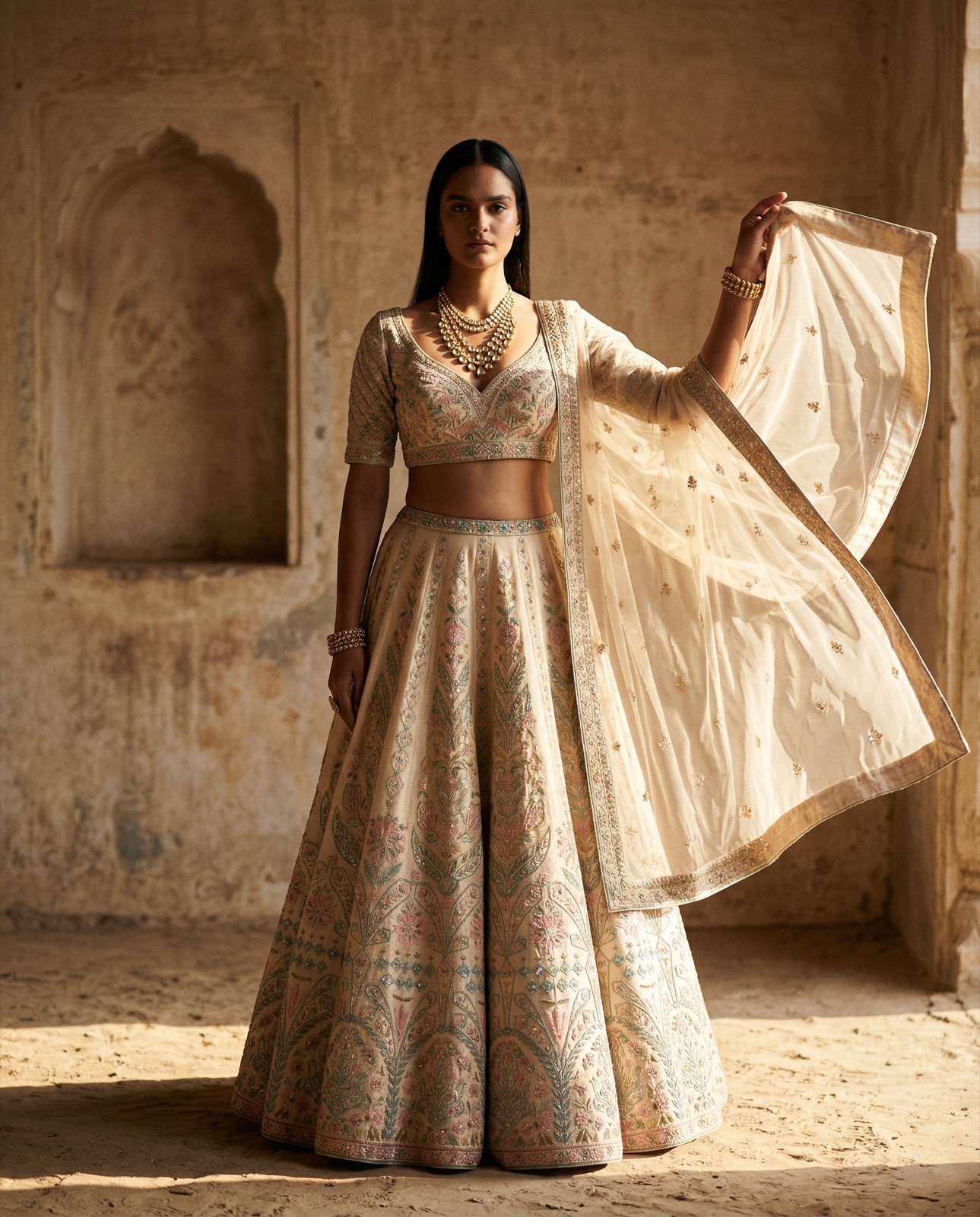
Apparel · bridal and occasion-wear

Bridal and occasion-wear photography that signals the price point before the bride hears it.

Bridal apparel campaign photography is the editorial production a couture or contemporary bridal label ships around the seasonal bridal-market window — New York Bridal Market in early April and October, London Bridal Week in late September, Paris Bridal Fashion Week in late September, and the South Asian couture window from late July through November. The bride and her mother read the handwork before they read the price card. The beadwork density, the soutache, the chantilly-lace ground, the dupioni weave, the silk-faille drape, the back of the gown — all of it has to read inside the first frame on Net-A-Porter Bridal, Moda Operandi Trunkshow Bride, Browns Bride, Bergdorf Goodman Bridal Salon, Saks Wedding, Aza Fashions and Pernia's Pop-Up Shop. A named-photographer campaign at one-hundred-fifty to four-hundred-fifty thousand covers the hero. The remaining one-hundred plus frames in the book fall on a one-to-three-designer in-house team and the bridal director. This is the production contract that holds the beadwork-fidelity discipline at three-hundred-percent across every frame and ships the bridal book at the editorial register the partner photo editor accepts on first send.

By Abhi Chawla, founder · Last updated: 2026-06-19

The register

The book reads at the handwork — produced as bridal apparel campaign photography.

The Wednesday morning the SS27 bridal book locks

It is the third Wednesday of January. The SS27 bridal book locks on Friday — fourteen gowns. A duchess-satin ballgown with hand-corded soutache across the bodice at twelve-thousand-four-hundred. A demi-couture mikado A-line with a hand-tatted chantilly-lace train at nine-eight-fifty. A silk-faille sheath with a removable bow at sixty-two-hundred. A dupioni column with French-knot embroidery at the neckline at fifty-eight-fifty. A tea-length silk-organza occasion piece at thirty-eight-hundred. A chiffon Grecian column for the destination bride at forty-two-fifty. A heavy-bead-and-pearl bodice over silk-faille skirt at eighteen-six. A sculptural mikado bow-back at fourteen-eight. A French-lace-over-silk slip at seventy-four-hundred. A demi-couture jumpsuit at forty-eight-fifty. A blush silk-faille gown at fifty-six-fifty. A cathedral-veil-anchor ballgown at twenty-two-eight. A Indian-silhouette lehenga choli with gota patti and zardozi at sixteen-four — the resort cross-over for the South Asian client. A reception slip dress with hand-sewn pearls at sixty-eight-fifty. The line list reads like the brand and the founder is proud of it. At nine-fourteen this morning the production company's bid for the campaign lands in the bridal director's inbox. Two days at a Hudson Valley estate with the named photographer the founder has wanted to work with since the brand opened in 2017. Twelve gowns shot, sixteen frames the photographer keeps. Photographer fee one-hundred-eighty-five thousand. Three model bookings, hair-and-makeup at the bridal-editorial tier, stylist, set with peonies and English garden roses, light, prop, transport, finishing, contingency. Three-hundred-twenty-eight thousand all-in. The bridal director reads it twice.

By ten-twenty the founder, the bridal director, the head atelier, the wholesale director and the CFO are in the small meeting room with the bid up on the screen. The CFO has the SS27 bridal unit economics on her iPad. The book is fourteen pieces at thirty-eight-hundred to twenty-two-eight wholesale, against a Net-A-Porter Bridal buy of roughly four-hundred-eighty thousand at the partner depth NAP has indicated, a Moda Operandi Trunkshow buy at three-hundred-twenty, a Browns Bride pack at one-hundred-forty, a Bergdorf Goodman Bridal Salon featured-designer commitment at one-hundred-twenty, a Saks Wedding partnership at ninety, the brand's own trunk-show tour across eight cities at two-hundred-sixty, the brand's own dot-com against trunk-show appointment-conversion at one-hundred-eighty, the Aza Fashions and Pernia's Pop-Up Shop South Asian pack at one-hundred-sixty, and two independent bridal boutiques at the Loho Bride and Carine's Bridal Atelier tier worth roughly seventy against the book. Total wholesale revenue lands at roughly one-point-eight to two-point-one million depending on partner depth. The named-photographer campaign at three-twenty-eight is between sixteen and eighteen percent of total wholesale revenue. Against book contribution margin — which the CFO calculates at forty-six percent on the couture tier and thirty-eight percent on the demi-couture and contemporary — the campaign lands at thirty-four to forty-one percent of book contribution. The CFO can absorb the hero day. She cannot absorb the wholesale-deck surface around it at the named-photographer day rate.

If you are reading this from inside a three-to-forty-million couture or contemporary bridal label — Mira Zwillinger-tier, Galia Lahav-tier, Reem Acra-tier, Monique Lhuillier-tier, Carolina Herrera-tier, Markarian-occasion-tier, Costarellos-tier, Halfpenny London-tier, Grace Loves Lace-tier, Savannah Miller-tier, Anita Dongre-tier, Sabyasachi-tier, Manish Malhotra-tier or Tarun Tahiliani-tier — you know the Wednesday morning the bid lands. This page is what the bridal book production contract looks like in practice — the beadwork-fidelity discipline at three-hundred-percent, the named-photographer pedigree as production contract, the atelier-vocabulary lock, the twelve-week sprint back from the bridal-market window, and the math against a named-photographer roster that covers the hero but leaves the partner deck and the PDP on a one-to-three-designer in-house team.
The bridal book is the wrong shape for a named-photographer-only roster

The structural problem with bridal books is that they require a handwork fluency the volume-DTC studio does not carry and a surface area the named-photographer day cannot cover. A Mira Zwillinger-tier or Galia Lahav-tier or Anita Dongre-tier seasonal bridal book typically ships at twelve to twenty-two gowns at thirty-eight-hundred to twenty-eight-thousand wholesale, with a one-hundred-twenty to two-hundred-twenty-frame editorial surface required to feed Net-A-Porter Bridal, Moda Operandi Trunkshow Bride, Browns Bride, Bergdorf Goodman Bridal Salon, Saks Wedding, the brand's own dot-com PDP carousel at five angles per gown, the trunk-show city pack the brand carries to New York, Los Angeles, Chicago, Dallas, London, Dubai and Mumbai, the Vogue Brides editorial submission set, the Klaviyo bridal-flow email hero into the appointment-conversion sequence, OOH for Bridal Fashion Week where the brand has placement, and the paid-media platform crops the brand runs against the engagement-season search window from November through February. The named-photographer campaign at one-hundred-fifty to four-hundred-fifty thousand covers ten to twenty-six frames. The math compounds against the in-house team for the remaining one-hundred-plus.

The bride and her mother read the handwork before they read the price card. They have followed the atelier on Instagram for three years before the appointment. They have read Vogue Brides on the named atelier's last season. They have watched the brand's Trunkshow reel on Moda Operandi twice. They know the difference between machine-applied beadwork at twenty-eight beads per square centimetre against atelier-hand application at fifty-four. They know hand-tatted chantilly against laser-cut. They know dupioni from shantung. They know which silhouette will read on their own frame at the trunk-show fitting before they confirm the four-hour appointment. The mistake is not the studio's technical execution. The mistake is the production model losing the atelier vocabulary inside the volume pass. A frame where the beadwork smooths under retouching reads as machine. A frame where the dupioni weave loses the slubs reads as polyester. A frame where the silk-faille drape flattens under finishing reads as fashion-bride rather than couture-bride. The bride who has saved for two years for the trunk-show appointment reads the wrongness inside one frame and the appointment does not get booked. Vogue Brides' atelier-coverage editorial through 2025 and BridalGuide's 2026 atelier panels both name handwork fidelity as the highest-leverage variable in the trunk-show conversion window.

The named-photographer campaign was built around the editorial hero, not the partner-deck surface. Tim Walker's English-romance bridal frames, Erik Madigan Heck's color-field bridal work for Vogue, Mario Sorrenti's luxury-romance register, Cass Bird's modern American bridal frames, Carlijn Jacobs's contemporary editorial register and Avinash Gowariker's South Asian couture pedigree all deliver an editorial moment the brand keeps for the season — sixteen to twenty-six frames against a two-day production, finishing held across three to four weeks. The frames are the editorial spine. The Net-A-Porter Bridal editorial cover surround cannot ship out of those twenty-six frames. The Moda Operandi Trunkshow gown-by-gown trunk hero cannot ship out of those twenty-six frames. The five-angle dot-com PDP carousel — front portrait, three-quarter back, full back, beadwork close-up, hem-and-train deployed — multiplied across fourteen gowns is seventy frames before the brand has shipped a single partner deck. The bridal director and the design lead have to source the remaining one-hundred-twenty to one-hundred-eighty frames from somewhere. That is the gap the volume-DTC studio fails to close and that the named-photographer day was never built to close. The fix is not a second campaign day. The fix is the right production model behind the campaign moment, the same way our AI vs traditional fashion photography piece describes the split for main-collection apparel.

Six rules that hold a bridal book

01

The atelier vocabulary is documented and locked

The brand-spine document for the bridal book names every handwork variable at the named atelier standard. Beadwork density at the named beads-per-square-centimetre against the house standard — fifty-four for the Mira Zwillinger-equivalent, forty-six for the Reem Acra-tier, sixty-eight for the heavy-Lebanese-couture register at Saiid Kobeisy. Soutache pattern at the named house repeat. Chantilly lace named by mill and run — Solstiss Calais, Sophie Hallette, Riechers Marescot. Dupioni and shantung named by silk mill — Atelier Bunad in Italy, Lazaro Cosmair in New York. Silk faille named by weight and weave count. Embroidery technique named by tradition — gota patti, zardozi, dabka, French-knot, Lunéville hook, tambour. Hem-finish and bustle named. The studio composes against the locked vocabulary. The frame reads at the handwork because the contract is the handwork.

02

Beadwork reads at three-hundred-percent close-up

Every wave-one frame holds a three-hundred-percent close-up companion that reads the beadwork, the lace ground, the embroidery technique and the silk hand. The bride zooms on PDP, on the Net-A-Porter Bridal editorial detail panel, on the Moda Operandi Trunkshow carousel back-of-gown view, and on the trunk-show appointment-booking page. The volume-DTC studio crops at the editorial level and treats the close-up as an afterthought finished by retouching. The beadwork-fidelity contract treats the close-up as the primary frame and the editorial as the carrier. The bride who reads the bead-and-sequin density at three-hundred-percent and recognises the atelier register confirms the appointment in twenty-eight seconds.

03

The named-photographer pedigree is the editorial spine

The brand chooses a named-photographer pedigree as the editorial reference for the book, named in the brief — Tim Walker for the romantic-heritage register, Erik Madigan Heck for the color-and-florals register, Mario Sorrenti for the luxury-romance register, Cass Bird for the modern American register, Carlijn Jacobs for the contemporary editorial register, Steven Meisel for the high-fashion bridal register, and Tarun Khiwal or Avinash Gowariker or Bharat Sikka for the South Asian couture register. The reference is the contract. Generic "romantic bridal" reads as generic. Named is defensible. The studio composes against the named reference frame by frame for every wave-one and wave-two frame the named photographer does not personally shoot.

04

The casting frame locks across the seasonal book

Three or four faces, locked across the entire SS or AW bridal drop — same models, same height-and-frame, same posture register, same hair finish, same skin tone, same neck-and-collarbone line. The bride is reading her own body against the model and the appointment is booked from that read. Mira Zwillinger has held a two-face casting frame across multiple seasonal books. Anita Dongre runs a recognisable South Asian face roster across resort and bridal. Reem Acra runs the same New York face on lookbook and editorial. Rotating across volume-DTC stock-cast freelancers per shoot day reads as a brand still finding its voice. The locked casting frame at the bridal tier is the editorial discipline and the appointment-conversion mechanic. The model-identity layer carries our AI fashion models vs real models piece at the bridal register.

05

The back-of-gown frame is non-negotiable

The bride confirms the trunk-show appointment from the back-of-gown view as often as from the front. The back is where the silhouette reads — bustle, train length, lace inset, button row, illusion mesh, low-back drape on silk faille. The volume-DTC studio composes the front portrait, treats the back as a finishing slot, and crops the train inside the frame. The back-of-gown contract treats the train deployed in full, the bustle architecture exposed, and the illusion-mesh hand-set buttons reading at three-hundred-percent. Every wave-one gown holds a front portrait, a three-quarter, a full back with train deployed, a back beadwork close-up and a hem-and-train close-up. Five frames per gown. Non-negotiable. Same composition discipline as the wholesale linesheet layer in our wholesale lookbook and linesheet piece, scaled to the bridal partner set.

06

Branding is held outside the frame

The wordmark and lockup live in the caption block, the lookbook caption and the trunk-show city-pack sleeve, not inside the editorial frame. The bride at the couture-bridal tier does not want to be told the brand. She wants to recognise it by the silhouette, the handwork, the casting, the named-photographer reference and the named atelier vocabulary. The frame that asserts the brand reads as the brand trying. The frame that holds the atelier vocabulary reads as the brand. Tim Walker did not put logos inside the Vogue bridal frames. Mira Zwillinger does not put the wordmark inside the editorial frame. The book that holds the same discipline reads at the same register.

What the three-hundred-percent close-up actually does

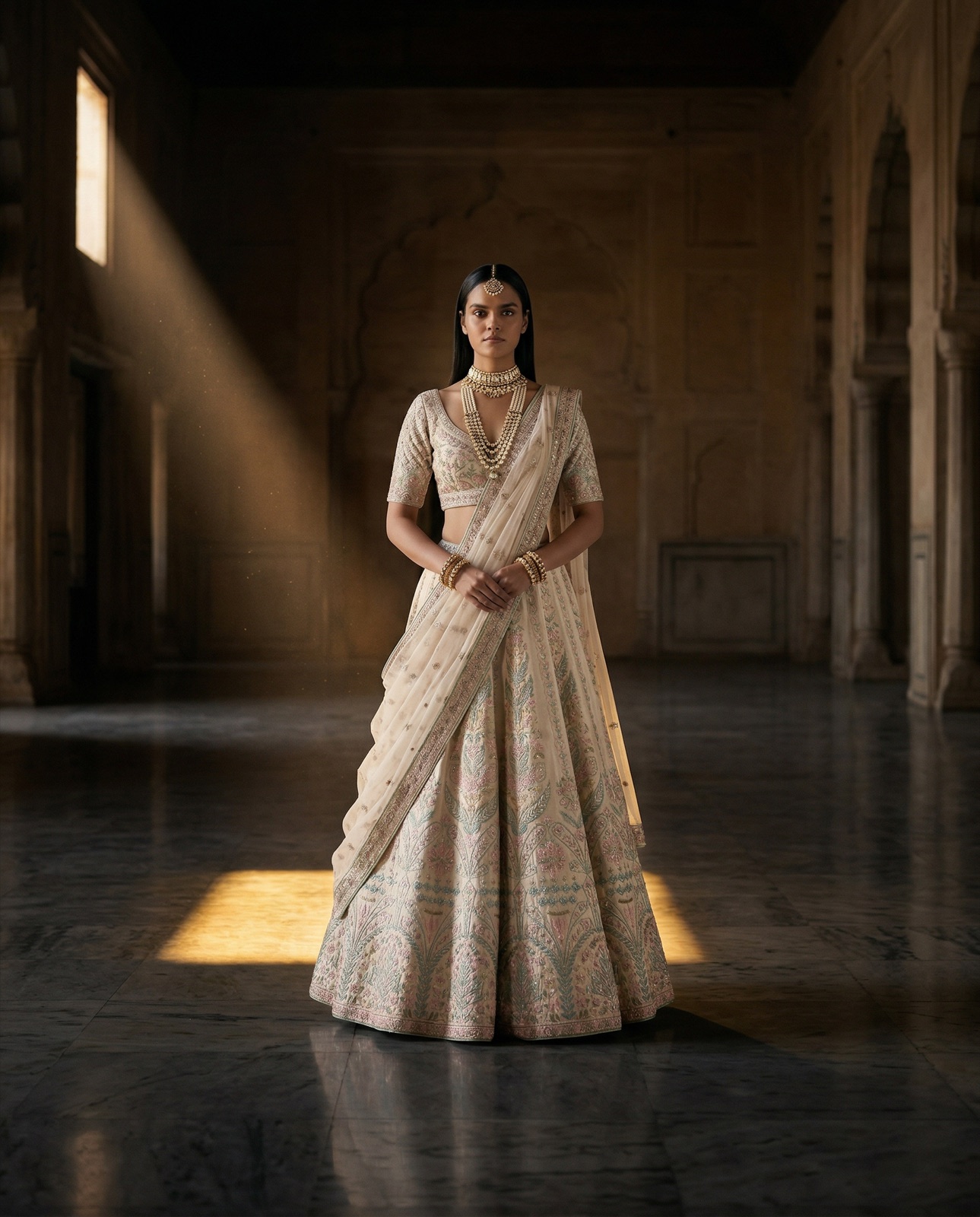
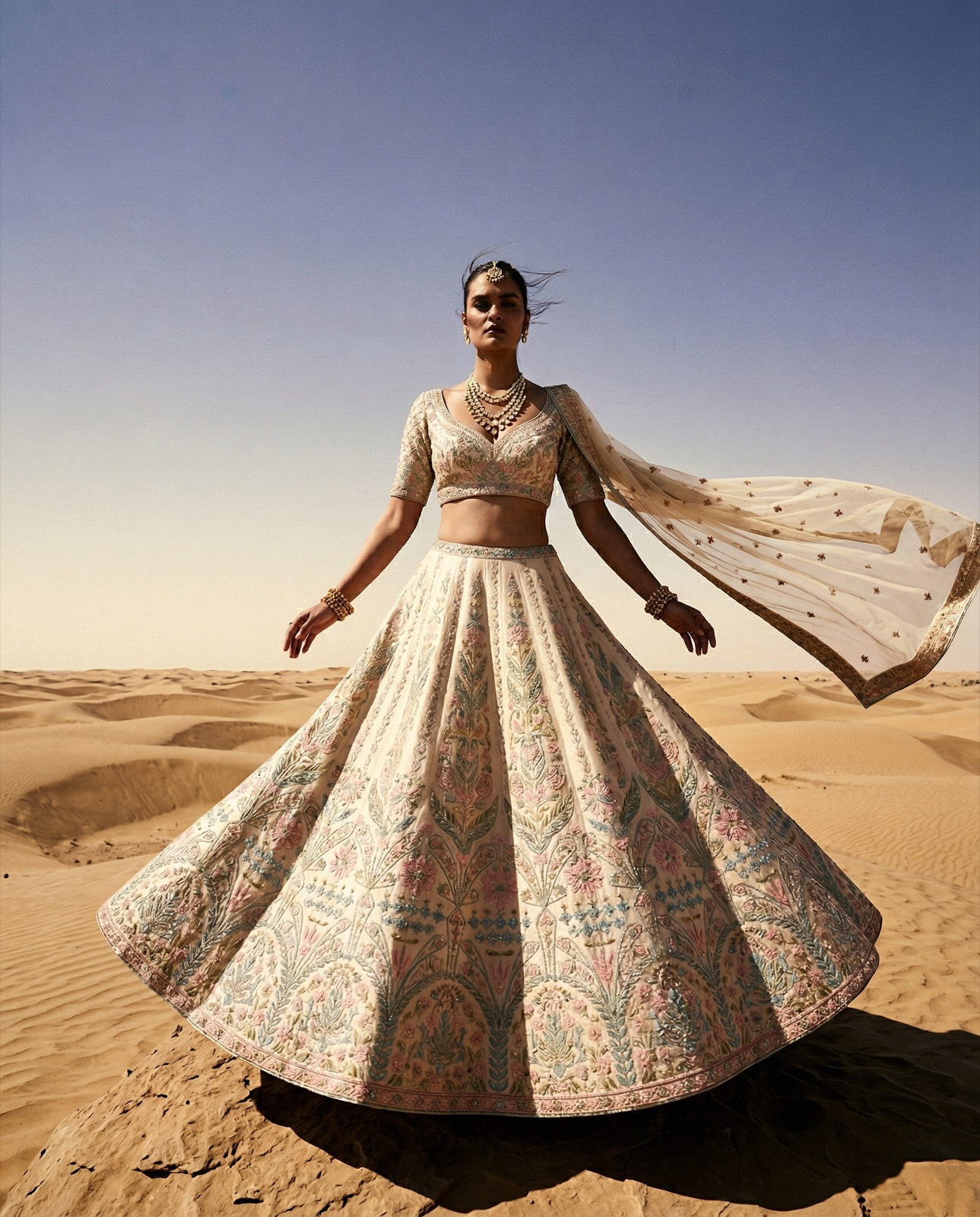
The three-hundred-percent close-up is the frame inside the lookbook spread that reads the atelier. Editorial frame in slot one shows the gown. Close-up in slot two reads the bodice beadwork at three-hundred-percent — the bead-and-sequin density, the soutache pattern, the French-knot grouping, the chantilly-lace ground. Close-up in slot three reads the silk hand at three-hundred-percent — the dupioni slubs preserved, the silk-faille weight on form, the duchess-satin sheen against the light value. Close-up in slot four reads the back-of-gown architecture at three-hundred-percent — the bustle, the illusion-mesh, the hand-set button row. Close-up in slot five reads the hem-and-train at three-hundred-percent — the horsehair finish, the lace edge, the cathedral-train length deployed on the floor. Slot six returns to the editorial frame from a second angle. The mother-of-bride who follows Vogue Brides reads the close-ups before the editorial. The bridal photo editor at Net-A-Porter Bridal reads the close-ups before she places the order. The trunk-show client books the four-hour appointment from the close-ups.

This is the discipline the volume-DTC studio loses inside the volume pass. The volume studio composes the editorial frame, treats the close-up as a finishing slot, retouches the bead density into uniformity, smooths the silk hand into a flat finish, and ships at the editorial register. The bride reads the smoothed bead-and-sequin field in one second and assigns the brand to the fashion-bride tier — not the couture-bride tier. The appointment does not get booked. The fix is to treat the close-up as a primary frame composed against the locked atelier vocabulary — the bead-and-sequin density at the named house standard, the silk hand at the named mill book number, the chantilly lace at the named Solstiss or Sophie Hallette run, the French-knot grouping at the named atelier repeat — and to compose against the named-photographer reference at every frame in the book. The brand-world contract detailed in our luxury apparel brand world piece is the upstream mechanic at the quiet-luxury womenswear register; the bridal contract carries the same discipline through to the three-hundred-percent beadwork-fidelity frame, with the back-of-gown layer added as the bridal-specific surface.

In the book

Three frames that read against the atelier vocabulary.

The three options

Named-photographer-only, volume DTC studio, or beadwork-fidelity-locked production.

Tier 1

The named-photographer-only campaign

One-hundred-fifty to four-hundred-fifty thousand all-in for a two-day campaign with a named photographer — Tim Walker, Mario Sorrenti, Steven Meisel, Erik Madigan Heck, Cass Bird, Carlijn Jacobs at the Western-couture tier, or Tarun Khiwal, Avinash Gowariker and Bharat Sikka at the South Asian couture tier. Photographer fees forty-eight to one-hundred-eighty thousand depending on the tier, plus the bridal-editorial talent-and-floral-and-set stack the register requires. Delivers the campaign hero, the editorial opening spread and roughly sixteen to twenty-six supporting frames. The signature moment the brand keeps if margin allows. Does not scale to the full Net-A-Porter Bridal editorial cover surround, the Moda Operandi Trunkshow gown-by-gown trunk hero, the Browns Bride lookbook, the Bergdorf Bridal Salon featured-designer pack, the Saks Wedding editorial, the Aza Fashions and Pernia's Pop-Up Shop South Asian pack, the dot-com PDP at five angles per gown, the trunk-show city pack, the Vogue Brides submission set, the Klaviyo bridal-flow email hero, OOH for Bridal Fashion Week or the paid-media platform crops. Against the SS or AW bridal book, lands at fourteen to twenty-four percent of book contribution depending on partner depth. The CFO can absorb the hero but only that. The per-frame economics in our AI photoshoot vs studio cost piece walks the math against the named-photographer day rate.

Tier 2

The volume DTC photography studio

Thirty-eight to ninety-four thousand per book for a high-throughput DTC studio shipping one-hundred-twenty to one-hundred-eighty frames. Reads as wrong-register at the couture-bridal tier — six-point lighting, smoothed bead-and-sequin density, lifted saturation, rotating cast, in-frame branding, retouched silk hand into a uniform finish, cropped trains and missing back-of-gown architecture. The studio is technically competent on a ready-to-wear category. It collapses on a bridal book. The beadwork reads at the studio's house density instead of the brand's. The dupioni loses the slubs under retouching. The chantilly lace flattens into a printed-on look. The bride who has saved for two years reads the wrongness inside one second and the appointment does not get booked. Net-A-Porter Bridal photo editors send back the editorial cover requesting recomposition. Moda Operandi rejects the trunk hero for register. The comparison detail tracks the production-model split in our AI vs traditional fashion photography piece.

Tier 3

The beadwork-fidelity-locked production (us)

Twenty-eight to sixty-four thousand per book for the full SS or AW bridal surface against the locked atelier vocabulary — editorial campaign frames around the named-photographer hero, Net-A-Porter Bridal editorial cover surround, Moda Operandi Trunkshow gown-by-gown trunk hero, Browns Bride lookbook, Bergdorf Goodman Bridal Salon featured-designer pack, Saks Wedding editorial, Aza Fashions and Pernia's Pop-Up Shop South Asian pack, full lookbook with three-hundred-percent beadwork-and-drape close-ups, dot-com PDP carousel at five angles per gown, trunk-show city pack, Vogue Brides editorial submission set, Klaviyo bridal-flow email hero pack, OOH adaptations and paid-media platform crops at five aspect ratios. Built on the brand-spine document, the named-photographer pedigree, the locked atelier vocabulary at handwork-and-silk measurement, the named cloth library and the locked casting frame. Holds the beadwork-fidelity discipline at three-hundred-percent and the back-of-gown frame as production discipline, not a finishing pass. Against the SS or AW bridal book, lands at two-and-a-half to four percent of book contribution — back inside the CFO's tolerance for a recurring SS-and-AW production line. The per-frame economics walk holds the line at one-hundred-eighty to three-hundred-forty per frame against the named-photographer's nine-hundred to twenty-four-hundred per usable frame on the campaign day.

The twelve weeks back from the bridal-market window

The bridal book sprint runs twelve weeks back from the bridal-market window. The SS book ships into the New York Bridal Market and the London Bridal Week in early April, with the Net-A-Porter Bridal and Moda Operandi Trunkshow partner editorial windows opening roughly two weeks earlier. The AW book ships into the October New York Bridal Market and the late-September Paris Bridal Fashion Week, with partner windows in mid-September. The South Asian couture window opens into the India Couture Week in late July through early August and the Lakmé Fashion Week bridal couture day in late August, with the trunk-show calendar opening in August through November against the Hindu wedding-season cluster. The compression matters. A named-photographer two-day production plus three-week post lands inside the calendar for the campaign hero. The remaining surface — full lookbook spreads with the back-of-gown architecture, partner-deck covers across six wholesale portals, dot-com PDP at five angles per gown, trunk-show city pack across eight cities, Vogue Brides submission set, Klaviyo bridal flow, paid-media — cannot wait for the photographer's roster to clear.

Week twelve is brand-spine ingestion and atelier-vocabulary lock. We sit down with the founder, the bridal director, the head atelier, the design lead and the wholesale director for one long afternoon and lock the spine for the book — the bead-and-sequin density at the named house standard, the soutache pattern repeat, the chantilly lace named by mill and run, the dupioni and silk-faille named by mill book number, the embroidery technique by tradition (French-knot, Lunéville hook, tambour, gota patti, zardozi, dabka, mukaish), the hem-finish-and-bustle architecture, the named-photographer reference the founder will defend, the editorial titles the bride reads (Vogue Brides, Brides, Martha Stewart Weddings, The Knot luxury vertical, BridalGuide editorial), the palette with hex codes against the dyed silk reference, the casting frame, the negative-space ratio at the couture-bridal register, the named light values in degrees Kelvin and the light angles in degrees against the named-photographer pedigree, the typography for the lookbook, and the line list against the partner editorial calendar. The brand-spine document for the bridal book runs roughly thirteen pages — tighter than a main-collection apparel document because the handwork layer adds measurement variables ready-to-wear does not carry. It reads more like an atelier's house manual than a creative brief. The upstream discipline tracks our apparel brand identity and campaign system piece; the bridal-specific layer inherits from it and adds the atelier vocabulary.

Weeks eleven and ten are casting-frame lock and editorial-reference selection. We lock the three or four faces against the brand's locked casting frame — typically inherited from the previous SS or AW book and refreshed at the margin against the new collection's neckline-and-back register. We compose four to six mood frames inside the atelier vocabulary against the named-photographer reference — Tim Walker for the English-romance, Erik Madigan Heck for the color-and-florals, Mario Sorrenti for the luxury romance, Cass Bird for the modern American, Avinash Gowariker for the South Asian couture. The mood frames are the moment the book either reads or does not. If they read at the founder's named-photographer reference, the book will read. If they do not, we go back to the spine.

Weeks nine and eight are wave one — the campaign hero, the Net-A-Porter Bridal editorial cover frame, the Moda Operandi Trunkshow trunk hero, the Browns Bride lookbook hero, the Bergdorf Bridal Salon featured-designer pack, the Saks Wedding editorial, the Aza Fashions or Pernia's South Asian pack hero, and the eight to twelve tentpole gown frames the book keeps. Every wave-one frame holds the three-hundred-percent beadwork-and-drape close-up companion and the back-of-gown frame. Where the brand has booked the named photographer for the campaign hero day, wave one absorbs the editorial spine and composes everything else against the named photographer's reference. Where the brand has not booked the named-photographer day, wave one ships entirely from the studio against the named-photographer reference, the locked atelier vocabulary and the casting frame.

Weeks seven and six are wave two — the full lookbook spreads with the back-of-gown architecture at three-hundred-percent, the dot-com PDP carousel at five angles per gown (front portrait, three-quarter back, full back with train deployed, back beadwork close-up, hem-and-train close-up) multiplied across fourteen gowns is seventy frames, the partner trunk-show city pack across New York, Los Angeles, Chicago, Dallas, London, Dubai and Mumbai, the Vogue Brides submission set with the editorial frames partner editors expect, the Klaviyo bridal-flow email hero into the appointment-conversion sequence, the partner editorial supplements for Brides, Martha Stewart Weddings and The Knot luxury vertical, and the South Asian portal pack for Aza Fashions, Pernia's Pop-Up Shop, Ogaan and Mélange where the brand ships into the Indian-bridal partner set. Wave two is the frames the season runs against. The cadence detail in our seasonal drop photography workflow piece tracks the equivalent rhythm at the main-collection register; bridal compresses to the bridal-market window.

Weeks five and four are paid-media platform crops at five aspect ratios for the engagement-season search window from November through February, and OOH adaptations for Bridal Fashion Week where the brand has the placement. Holding the negative space, the model identity, the light direction, the colour register and the atelier vocabulary across every aspect ratio is the discipline that breaks in volume-DTC studios. A nine-by-sixteen Reels crop cannot read as a different brand than the Net-A-Porter Bridal editorial cover. The same locked frame, cropped to nine aspect ratios, ships to every placement. Weeks three through one are the trunk-show city pack delivery against the brand's tour, press to Vogue Brides, Brides, Martha Stewart Weddings, The Knot luxury vertical, BridalGuide editorial and the South Asian editorial set, final QC against the brand-spine document, and DAM ingestion into the in-house team's Frame.io and Bynder stack. Every frame in the book's pack runs through the brand-spine checklist. If a frame fails, it goes back before launch lock.

The math against the bridal book contribution line

The bridal book contribution line is the math the CFO runs the day the line list locks. A fourteen-gown SS bridal book at thirty-eight-hundred to twenty-two-eight wholesale lands at total wholesale revenue between one-point-six and two-point-three million depending on Net-A-Porter Bridal, Moda Operandi Trunkshow, Browns Bride, Bergdorf Goodman Bridal Salon, Saks Wedding, Aza Fashions, Pernia's Pop-Up Shop and own trunk-show depth. Contribution margin at the couture tier sits around forty-six percent and around thirty-eight percent on the demi-couture and contemporary. Blended contribution lands at forty-one to forty-three percent — call it between six-hundred-sixty thousand and nine-hundred-ninety thousand on book contribution. Common Thread Collective's bridal-and-occasion-wear operator audits through 2025 and 2026 and Andrew Foxwell's apparel-vertical panel coverage track the same range across the couture-and-contemporary-bridal tier. A named-photographer-only campaign at three-twenty-eight thousand absorbs the hero day but cannot deliver the partner-deck surface. A second campaign day at the same photographer's day rate doubles the line item. The CFO holds the line at the campaign hero.

The beadwork-fidelity-locked production contract changes the math on the other end. The remaining one-hundred-twenty to one-hundred-eighty frames in the book ship from the studio at twenty-eight to sixty-four thousand against the brand-spine document, the named-photographer reference, the locked casting frame and the cloth-and-handwork library. The book clears contribution. The in-house team labour load drops because the bridal director and the design lead stop being the producers on the supporting frames; they review against the brand-spine document and approve at wave-one and wave-two milestones. The same bridal-director-and-design-lead pair who would otherwise spend six weeks producing the Net-A-Porter Bridal editorial surround, the Moda Operandi Trunkshow gown-by-gown trunk hero, the Browns Bride lookbook, the Bergdorf Bridal Salon featured-designer pack and the dot-com PDP at five angles per gown spend two weeks of review against the brand-spine document. The CFO sees the supporting line item drop by sixty to seventy-eight percent at the same editorial register. The founder feels the SS or AW calendar relax.

The replacement is not a downgrade. The brand-spine document is the contract that holds the editorial register at the named-photographer pedigree. The studio's house style is invisible by design. The named-photographer reference is the contract and the studio composes against it. The bride cannot tell the wave-one frames were not shot on the named photographer's second day, because the brand spine — the locked atelier vocabulary at bead-and-sequin density, the named cloth list, the named casting, the named light, the named editorial reference — is enforced as a production discipline rather than as a creative whim. Our Anita Dongre brand-spine project held exactly this mechanic at the Indian-couture-bridal register across a full year of editorial and lookbook production — the same brand-world studio model carrying the slow-craft house's atelier vocabulary against a Bharat Sikka and Avinash Gowariker pedigree.

For brands with the named-photographer hero booked — the campaign moment the brand keeps with Tim Walker, Mario Sorrenti, Cass Bird, Erik Madigan Heck or Carlijn Jacobs at the Western tier, or Tarun Khiwal, Bharat Sikka and Avinash Gowariker at the South Asian tier — the beadwork-fidelity-locked contract takes the supporting surface around it. Net-A-Porter Bridal editorial cover surround, Moda Operandi Trunkshow gown-by-gown trunk hero, Browns Bride lookbook, Bergdorf Bridal Salon featured-designer pack, Saks Wedding editorial, Aza Fashions and Pernia's South Asian pack, full lookbook with three-hundred-percent beadwork-and-drape close-ups, dot-com PDP at five angles per gown, trunk-show city pack across eight cities, Klaviyo bridal flow and OOH all ship from the studio inside the in-house team's calendar at the editorial register the partners expect. The named-photographer campaign remains the flagship visual moment. The studio holds the book around it. For brands without the named-photographer day, the book ships entirely from the studio against the named-photographer reference, the locked atelier vocabulary and the casting frame. Same brand-spine document, same beadwork-fidelity measurement layer, same cloth library, same casting, same named editorial reference, same twelve-week calendar. The Net-A-Porter Bridal editorial cover reads as Tim Walker or Cass Bird. The bride recognises the register inside the first frame. The book clears contribution and the SS or AW book ships at the partner editorial register the wholesale photo editor accepts on first send.

Where the bridal contract fits sharpest

The beadwork-fidelity-locked contract fits sharpest across five bridal-and-occasion-wear brand tiers, each with a distinct named-photographer pedigree and a distinct atelier vocabulary the bride associates with the brand. The English-romance and heritage-couture tier — Tim Walker's bridal canon, Phillipa Lepley London, Halfpenny London, Suzanne Neville, Jenny Packham, Stewart Parvin — sits against a Tim Walker and Erik Madigan Heck editorial pedigree, an English country house or Cotswolds garden named-environment register, a duchess-satin and silk-mikado cloth library, French-lace overlays from Sophie Hallette and Solstiss, and a softer-light register at thirty-six-hundred Kelvin. The bride reads the register against Vogue Brides UK and the Tatler Bride canon. The wholesale window opens into Net-A-Porter Bridal, Browns Bride and the brand's own London townhouse trunk-show calendar.

The New York luxury-couture tier — Mira Zwillinger, Galia Lahav, Reem Acra, Monique Lhuillier, Carolina Herrera, Vera Wang, Naeem Khan — sits against a Mario Sorrenti, Steven Meisel and Cass Bird editorial pedigree, a Manhattan townhouse, Hamptons estate or Tribeca atelier named-environment register, a duchess-satin, silk-faille and chantilly-lace cloth library, heavy bead-and-pearl handwork from the named atelier, and the editorial register that ships into Net-A-Porter Bridal's Manhattan editorial, the Bergdorf Goodman Bridal Salon featured-designer carousel, the Saks Wedding editorial vertical, the Moda Operandi Trunkshow gown-by-gown trunk and the Manhattan trunk-show salon tour. The wholesale window also opens into the Reem Acra-tier showroom and Mark Ingram Atelier wholesale partnership for the Manhattan flagship trunk window.

The Mediterranean couture tier — Galia Lahav at the harder Tel Aviv register, Saiid Kobeisy, Zuhair Murad couture, Tony Ward couture, Ines Di Santo, Costarellos — sits against a Mario Sorrenti and Carlijn Jacobs editorial pedigree, a Mediterranean villa or Beirut atelier named-environment register, a heavier silk-faille-and-mikado cloth library with high-density bead-and-sequin work at sixty-eight beads per square centimetre, French-knot embroidery at the Lebanese-couture density and a stronger directional light at five-thousand Kelvin reading the surface relief on the gown. The wholesale window opens into Net-A-Porter Bridal's Mediterranean edit, Moda Operandi Trunkshow, the Saks Wedding editorial and the brand's own Beirut and Athens trunk windows.

The contemporary-bridal tier — Markarian occasion, Halfpenny London's contemporary book, Savannah Miller, Grace Loves Lace, Anomalie, BHLDN's house-line, Reformation Bridal, Loho Bride's exclusive labels, Catherine Deane — sits against a Cass Bird and Carlijn Jacobs contemporary pedigree, a Brooklyn warehouse, Hudson Valley garden or California beach named-environment register, a silk-crepe, silk-organza and silk-charmeuse cloth library, lighter hand-tatted chantilly and minimalist embroidery, and a softer modern light at four-thousand-two-hundred Kelvin. The wholesale window opens into Net-A-Porter Bridal's contemporary edit, Browns Bride, BHLDN's editorial, Anthropologie Weddings and the brand's own DTC-first trunk-show pop-ups. The contemporary tier compresses the bridal calendar against the modern-bride engagement-season search window and the social-organic register the modern bride lives inside.

The South Asian couture-bridal tier — Anita Dongre, Sabyasachi, Manish Malhotra, Tarun Tahiliani, Ridhi Mehra, Anamika Khanna and the contemporary tier underneath them — sits against a Tarun Khiwal, Avinash Gowariker, Bharat Sikka and Sushant Chhabria editorial pedigree, a Jaipur palace, Mumbai workroom, Calcutta atelier or Delhi haveli named-environment register, a silk-tissue, silk-zari, brocade and tulle cloth library, dense gota patti, zardozi, dabka, aari, mukaish, kamdani and resham handwork at the named atelier standard, and a warmer light register at thirty-four-hundred to thirty-six-hundred Kelvin reading the gold and silver thread surface. The wholesale window opens into Aza Fashions, Pernia's Pop-Up Shop, Ogaan, Mélange and the brand's own pop-ups in New York, London, Dubai and Singapore against the Hindu wedding-season cluster from August through November. The discipline carries our AI fashion photography service at the South Asian couture register; the broader category fit is mapped in our best AI fashion photography services piece; the lookbook surface in our AI lookbook photography piece details the wave-two delivery layer; and the broader spine reads against our DTC clothing brand photography playbook.

What a frame looks like when it passes the bridal test

The bridal test runs on every frame the studio composes for the SS or AW book. The test is one paragraph on the brand-spine document. Beadwork reads at the named beads-per-square-centimetre against the house standard. Soutache reads at the named house repeat. Chantilly lace reads against the dyed silk underlayer at the Solstiss or Sophie Hallette run. Silk hand reads on form — duchess satin, silk faille, dupioni, mikado, jacquard — at the named mill book number. Hem-and-train reads deployed in full, horsehair finish visible, lace edge at the atelier hand-finish. Back of gown reads at three-hundred-percent — bustle architecture exposed, illusion-mesh and hand-set buttons reading. Casting frame reads as the locked three-or-four-face roster. Editorial reference reads against the named photographer — Tim Walker, Mario Sorrenti, Steven Meisel, Erik Madigan Heck, Cass Bird, Carlijn Jacobs at the Western tier, or Tarun Khiwal, Avinash Gowariker and Bharat Sikka at the South Asian tier. Light reads at the named Kelvin and the named angle. Colour register reads at sub-three Delta E against the dyed silk swatch. Branding is held outside the frame. Eleven things. Every frame. No exceptions.

What it looks like when it works: the bride who follows the brand on Instagram for three years opens the Net-A-Porter Bridal editorial on the partner window opening day and the atelier vocabulary reads inside the first frame. She recognises the beadwork density, the silk hand, the back-of-gown architecture, the named-photographer reference and the casting before the wordmark appears. The trunk-show appointment is booked from the mobile carousel scroll on the same day. Her mother books a second appointment for the second-choice gown. The Moda Operandi Trunkshow page lands the brand four to twelve points above the partner's bridal average — the range we have seen across bridal books we have produced, consistent with Common Thread Collective's bridal-and-occasion-wear audits and BridalGuide's 2025–2026 partner-channel panels. The Net-A-Porter Bridal photo editor accepts the editorial cover on first send. The Browns Bride lookbook ships. The Bergdorf Bridal Salon featured-designer pack is approved on first review. The Vogue Brides editor sees the press-kit frames and books the brand for the SS bridal feature. The trunk-show city pack reads at the same register in New York, Los Angeles, London, Dubai and Mumbai.

What it looks like when it does not work: the Net-A-Porter Bridal editorial cover comes back with a recomposition request — the beadwork density reads off, the chantilly lace flattens under retouching, the train is cropped inside the frame. The Moda Operandi Trunkshow trunk hero is rejected for register and the bridal director spends Friday afternoon re-cropping. The Browns Bride lookbook is downgraded from full editorial to PDP-only treatment. The Bergdorf Bridal Salon featured-designer slot is held. The Aza Fashions partner pack is delayed. The Vogue Brides editor passes. The book's contribution lands below the CFO's target. The trunk-show calendar shows ten percent fewer bookings than the previous season. The founder is on the phone to a second-tier photographer in May doing the math on AW book production at a wedding-photographer day rate. We have walked into rooms where exactly that has happened.

The bridal test is a production contract. The discipline operates on every frame from the Net-A-Porter Bridal editorial cover down to the nine-by-sixteen Reels crop and the Aza Fashions South Asian portal pack. The frame that fails the test goes back before it ships. The bride the brand was built for can read the atelier vocabulary inside one frame and assign the brand to a tier in the second. The book sits beneath a broader apparel brand-world practice we document elsewhere: the brand-world model for in-house creative teams details how the same editorial-register lock works at the main-collection scale; the luxury apparel brand world piece shows the same mechanic at the quiet-luxury womenswear register; the apparel rebrand campaign relaunch piece holds the post-identity-refresh sequence; the wholesale lookbook and linesheet imagery piece details the wholesale-deck composition layer at the main-collection register; the knitwear lookbook and texture-storytelling piece holds the equivalent texture-fidelity discipline at the slow-fashion knitwear register; the Anita Dongre brand-spine project documents the same mechanic at the South Asian couture-bridal register; and the apparel ad creatives page is the throughput frame for the broader brand world.

Bridal and occasion-wear book · frequent questions

What is bridal and occasion-wear apparel campaign and editorial imagery?

Bridal and occasion-wear apparel campaign and editorial imagery is the editorial production a couture or contemporary bridal label ships around the seasonal bridal-market window — New York Bridal Market in early April and October, London Bridal Week in late September, Paris Bridal Fashion Week in late September, and the South Asian bridal calendar around the Mumbai and Delhi couture weeks in late July through August. The imagery reads against a named atelier lineage the bride and her mother associate with the register — Mira Zwillinger Tel Aviv handwork, Galia Lahav Israeli-couture drama, Reem Acra New York romance, Monique Lhuillier American luxury, Carolina Herrera ballgown formality, Vera Wang sculptural minimalism, Anita Dongre slow-craft Indian-bridal, Sabyasachi Calcutta-couture maximalism — and holds the beadwork-fidelity discipline at three-hundred-percent close-up so the soutache, the bead-and-sequin density, the chantilly lace, the dupioni weave and the silk-faille drape all read inside the editorial frame.

Why does a Tim Walker or Mario Sorrenti named-photographer bridal campaign break the couture unit economics?

A named-photographer bridal campaign at the Tim Walker, Mario Sorrenti, Steven Meisel, Erik Madigan Heck, Cass Bird or Carlijn Jacobs tier lands at one-hundred-fifty to four-hundred-fifty thousand dollars all-in for a two-day production with one location, ten to fourteen gowns shot, three to four model bookings and the hair-makeup-stylist-set-flowers stack the bridal-editorial register requires. The campaign delivers between sixteen and twenty-six usable frames. The bridal book the label has to ship runs at one-hundred-twenty to two-hundred-twenty frames — campaign hero, full lookbook with every gown across five angles, Net-A-Porter Bridal editorial cover, Moda Operandi Trunkshow trunk hero, Browns Bride lookbook, Bergdorf Goodman Bridal Salon featured-designer pack, Saks Wedding editorial, the South Asian partner pack for Aza Fashions and Pernia's Pop-Up Shop, dot-com PDP carousel, the bridal-trunk-show city pack, the Vogue Brides editorial submission set, OOH for Bridal Fashion Week and paid-media crops. The named-photographer moment covers the campaign hero. The remaining one-hundred plus frames fall on a one-to-three-designer in-house team.
How is bridal and occasion-wear imagery different from a main-collection apparel campaign?

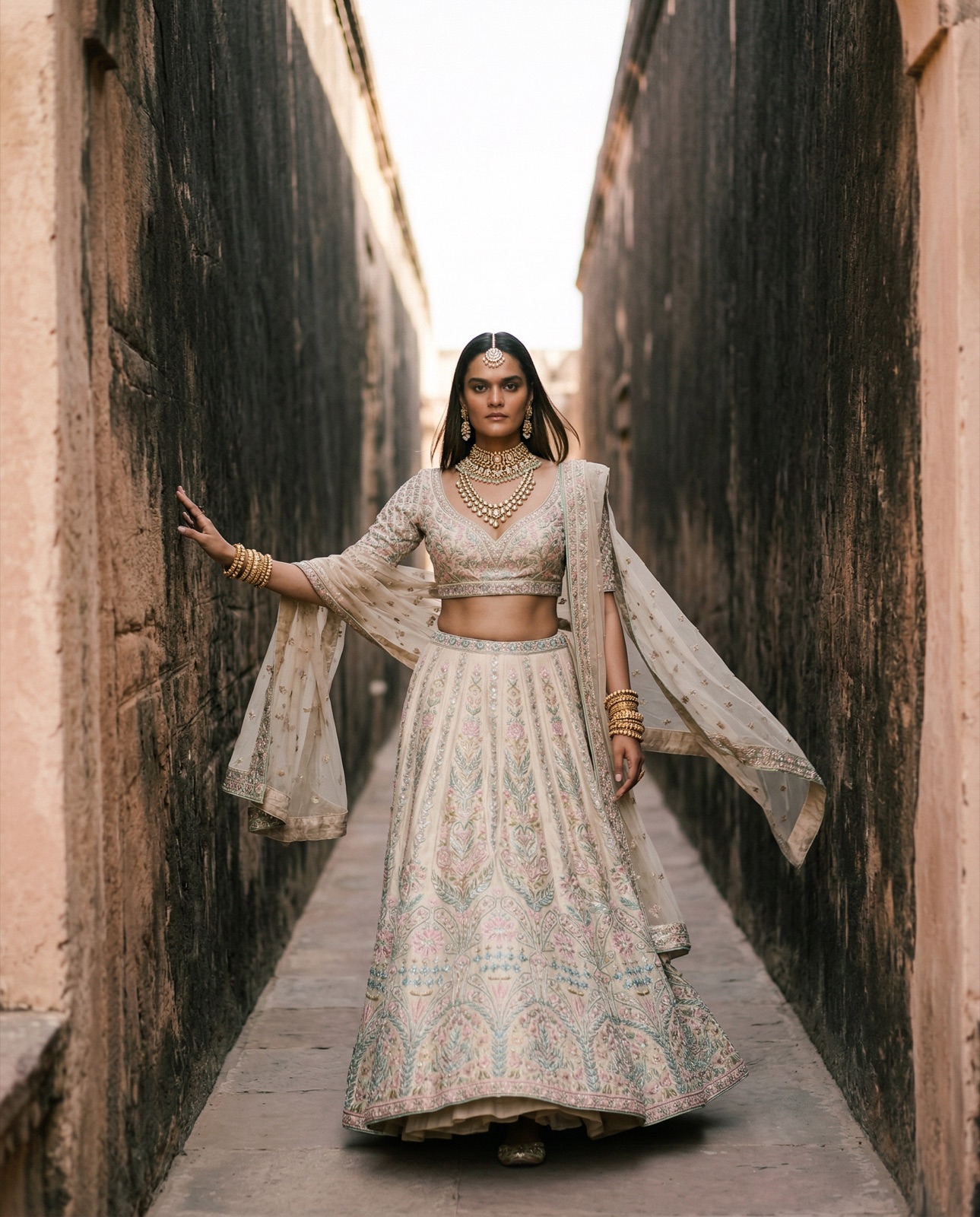
Five structural differences. The handwork — beadwork density, soutache, French-knot embroidery, gota patti, zardozi, hand-tatted chantilly — has to read at three-hundred-percent close-up because the bride's mother and the trunk-show client both zoom on that frame before they confirm the appointment. The drape on heavy goods — duchess satin, silk mikado, silk faille, dupioni, jacquard with metallic ground — has to hold gravity on form without retouched flattening that misrepresents the actual hand. The casting frame is tighter than ready-to-wear because the bride is reading her own body against the model. The trunk-show calendar runs against a bridal-market window the brand cannot move. And the partner-portal composition for Net-A-Porter Bridal, Moda Operandi Trunkshow, Browns Bride and Bergdorf Bridal Salon runs distinct from main-collection wholesale spec.

What is the beadwork-fidelity discipline and why does it matter?

The beadwork-fidelity discipline is the production contract that locks every bridal frame to a documented set of visual rules at the handwork — bead-and-sequin density per square centimetre at the named atelier standard, soutache stitch reading at three-hundred-percent close-up, French-knot embroidery without smoothing under finishing, chantilly-lace ground reading against the dyed silk underlayer, zardozi or gota patti at the verified gold or silver weight, dupioni slubs preserved in the weave rather than retouched out, and silk-faille drape reading the actual hand on form. The bride and her mother read the handwork inside the first frame and assign the gown to a tier — couture register, demi-couture register, contemporary-bridal register — before they read the price card. Vogue Brides' atelier-coverage editors and BridalGuide's atelier-review panels consistently name handwork fidelity as the single highest-leverage variable in the trunk-show conversion window.

How do you ship a bridal campaign without a Tim Walker day rate?

By treating the named-photographer pedigree as a production contract rather than a roster commitment. The brand chooses the editorial reference — Tim Walker for the romantic-heritage register, Erik Madigan Heck for the color-and-florals register, Cass Bird for the modern American register, Mario Sorrenti for the luxury-romance register, Carlijn Jacobs for the contemporary-editorial register, Tarun Khiwal or Avinash Gowariker for the South Asian couture register — and locks the reference in the brief as the editorial spine. The studio composes against the named reference frame by frame, holds the beadwork-fidelity discipline at three-hundred-percent, runs the locked casting frame across the seasonal collection, and ships the campaign hero, the full lookbook with every gown across five angles, the partner-portal covers and the dot-com PDP from inside the in-house team's calendar at the editorial register the named-photographer reference defends.

What kind of brands does the bridal and occasion-wear contract fit?

Couture and contemporary bridal labels at roughly three to forty million in revenue shipping a seasonal bridal book — brands at the register of Mira Zwillinger, Galia Lahav, Reem Acra, Monique Lhuillier, Carolina Herrera, Vera Wang, Pronovias, Markarian occasion, Costarellos and the contemporary tier underneath them (Markarian, Halfpenny London, Savannah Miller, Grace Loves Lace, Anomalie, BHLDN's house-line, Reformation Bridal), and the South Asian couture-bridal tier — Anita Dongre, Sabyasachi, Manish Malhotra, Tarun Tahiliani, Ridhi Mehra, Anamika Khanna. The fit is sharpest where the bridal book ships into Net-A-Porter Bridal, Moda Operandi Trunkshow Bride, Browns Bride, Bergdorf Goodman Bridal Salon, Saks Wedding, Lane Crawford bride, Aza Fashions, Pernia's Pop-Up Shop and the brand's own trunk-show tour, and where the founder has done the math on a one-hundred-fifty-to-four-hundred-fifty-thousand named-photographer campaign at least once.

How does the bridal-market sprint work back from the trunk-show window?

Twelve weeks back from the bridal-market opening. Week twelve is brand-spine ingestion and atelier-vocabulary lock with the founder, the head atelier, the bridal director and the design lead. Weeks eleven and ten are casting-frame lock and editorial-reference selection against the named-photographer pedigree. Weeks nine and eight are wave one — campaign hero, Net-A-Porter Bridal editorial cover, Moda Operandi Trunkshow hero, Browns Bride lookbook hero, Bergdorf Bridal Salon featured-designer pack, the eight to twelve tentpole gown frames the book keeps. Weeks seven and six are wave two — full lookbook spreads with three-hundred-percent beadwork-and-drape close-ups, dot-com PDP carousel with five angles per gown, partner trunk-show city pack, Vogue Brides editorial submission set, Klaviyo bridal-flow email hero and Aza Fashions or Pernia's pack where the brand ships into the South Asian portal set. Weeks five and four are paid-media platform crops and OOH for Bridal Fashion Week. Weeks three through one are trunk-show city pack, press to Vogue Brides, Brides, Martha Stewart Weddings, The Knot luxury vertical, BridalGuide editorial and the South Asian editorial set, final QC and DAM ingestion.

Will the imagery hold against Net-A-Porter Bridal, Moda Operandi Trunkshow and Browns Bride house specs?

Yes. Every wave-one and wave-two frame ships cropped at the partner's house spec from the same composition. Net-A-Porter Bridal runs the editorial three-by-four portrait against an off-white sweep with the beadwork close-up in carousel slot two and a drape-on-form frame in slot three. Moda Operandi Trunkshow runs the lighter editorial portrait at three-by-four for the trunk hero and a back-detail close-up at fifty percent of the carousel — the trunk client confirms the appointment from the back-of-gown view as often as the front. Browns Bride runs the modern-romantic three-by-four with a clean caption block. Bergdorf Bridal Salon runs the salon-portrait register with the train deployed at the named angle. Saks Wedding runs a softer editorial register with a flat-lay back-detail companion. The studio holds the brand spine across all five crops from the same locked frame.

Does the contract cover the South Asian bridal couture window separately?

Yes. South Asian bridal couture — Anita Dongre, Sabyasachi, Manish Malhotra, Tarun Tahiliani, Ridhi Mehra, Anamika Khanna and the contemporary tier underneath — runs on a distinct calendar around the India Couture Week window in late July and the Lakmé Fashion Week bridal couture day, with the trunk-show calendar opening in August through November against the Hindu wedding-season cluster. The partner set runs through Aza Fashions, Pernia's Pop-Up Shop, Ogaan, Mélange and the brand's own pop-ups in New York, London, Dubai and Singapore. The handwork discipline at gota patti, zardozi, dabka, aari, mukaish, kamdani and resham embroidery is non-negotiable at three-hundred-percent close-up. The named editorial pedigree runs Tarun Khiwal, Avinash Gowariker, Sushant Chhabria and Bharat Sikka rather than the Western set. Same brand-spine document mechanic. Different vocabulary.

Start a book

Bring us the bridal line list. Beadwork-fidelity intact.

If you are a founder, bridal director, CMO or head atelier at a three-to-forty-million couture or contemporary bridal label with an SS or AW bridal book shipping into Net-A-Porter Bridal, Moda Operandi Trunkshow, Browns Bride, Bergdorf Goodman Bridal Salon, Saks Wedding, Aza Fashions, Pernia's Pop-Up Shop or your own trunk-show tour — send the line list. The atelier vocabulary will be locked in the first week at bead-and-sequin density, silk hand and embroidery technique against the house standard, the named-photographer pedigree stays yours, and the supporting surface — Net-A-Porter Bridal editorial cover, Moda Operandi Trunkshow gown-by-gown trunk hero, Browns Bride lookbook, Bergdorf Bridal Salon featured-designer pack, full lookbook with three-hundred-percent beadwork close-ups and the back-of-gown architecture, dot-com PDP at five angles per gown, trunk-show city pack, Klaviyo bridal flow, OOH and paid-media crops — ships inside your in-house team's calendar at the editorial register the wholesale photo editor accepts on first send. The book clears contribution. The bride recognises the handwork inside the first frame.

Book a bridal book call